


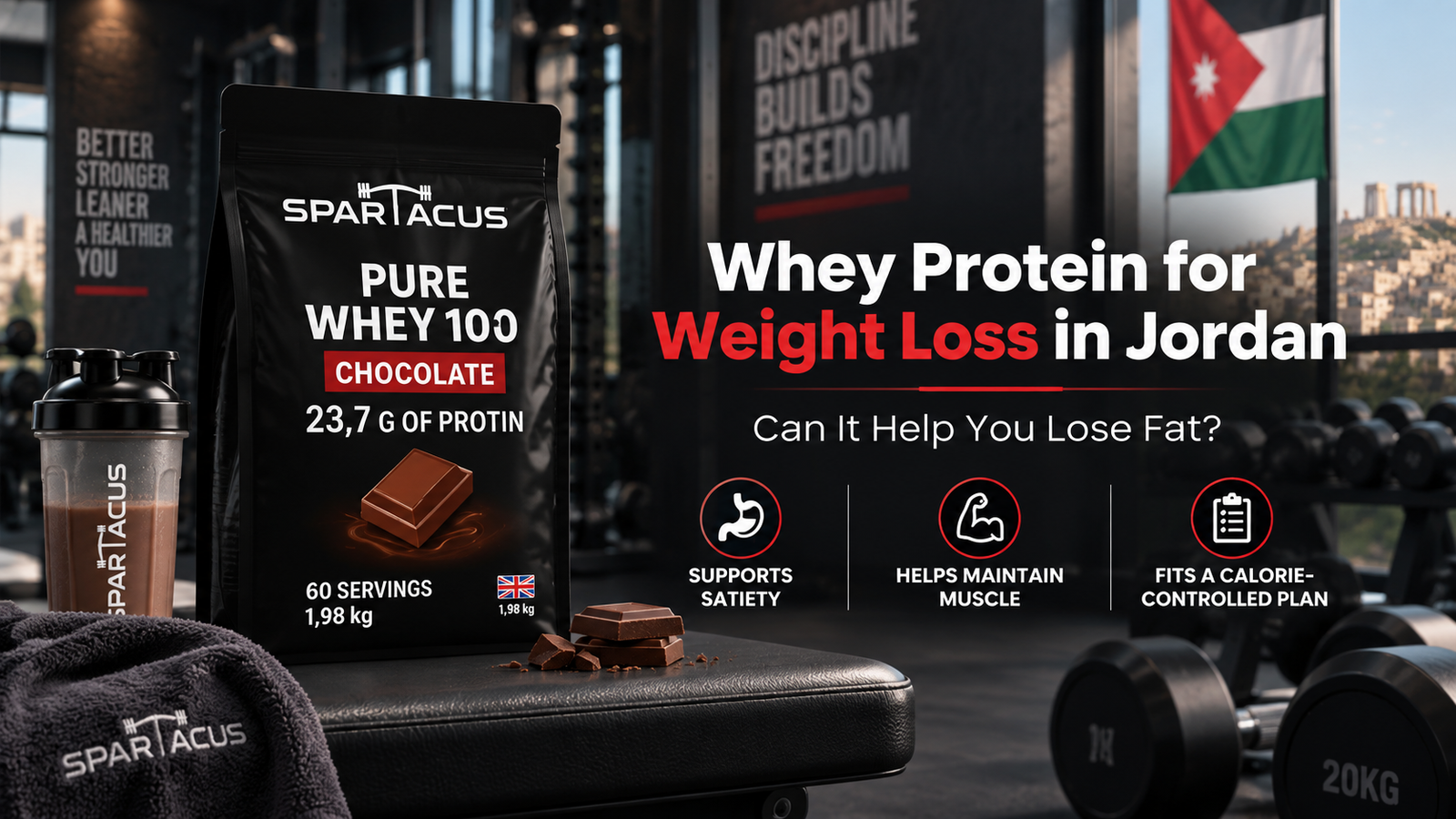
If you are looking for whey protein for weight loss in Jordan, the first thing to understand is that whey protein does not directly burn body fat.
Weight loss still depends mainly on maintaining an appropriate calorie deficit over time.
However, whey protein can be useful during a fat-loss phase because it can help you:
- Increase daily protein intake
- Support muscle retention while dieting
- Improve fullness for some people
- Recover from resistance training
- Make a calorie-controlled diet easier to structure
Research suggests that whey protein may support body-composition goals, especially when combined with resistance training and an overall calorie-controlled diet.
What Is Whey Protein?
Whey protein is a complete protein derived from milk.
It contains all essential amino acids and is digested relatively quickly compared with some other protein sources. The NIH notes that whey is one of the complete proteins commonly used in protein powders and sports nutrition products.
Whey protein is commonly used by:
- Gym-goers
- Athletes
- People trying to build muscle
- People trying to maintain muscle while losing fat
- People who struggle to reach their daily protein target through food alone
Can Whey Protein Help With Weight Loss?
Whey protein can support a weight-loss plan, but it is not a fat burner.
Its value comes mainly from helping you maintain adequate protein intake while controlling total calories.
Some research has found that whey supplementation may support changes in body composition, including reductions in fat mass and improvements in lean mass, although results vary between studies.
The most important point is:
Whey protein can support your diet, but it does not replace a calorie deficit.
Does Whey Protein Burn Fat?
No.
Whey protein does not directly burn fat.
Fat loss occurs when your body consistently uses more energy than you consume.
Whey protein may help indirectly by:
- Increasing protein intake
- Supporting fullness
- Helping maintain lean mass
- Making meals more structured
- Supporting resistance training
That can make a fat-loss plan easier to follow.
Can Whey Protein Help You Feel Full?
Protein is generally more filling than many lower-protein foods.
Research examining whey protein and appetite has found that whey may reduce longer-term appetite in some contexts, although short-term effects have not been consistent across all studies.
This means whey can be useful as part of a calorie-controlled diet, but you should not expect it to eliminate hunger completely.
Why Is Protein Important During Weight Loss?
When you lose weight, you want as much of that loss as possible to come from body fat rather than muscle.
Adequate protein intake becomes especially important when calories are lower.
Protein helps support:
- Muscle maintenance
- Recovery
- Training performance
- Satiety
- Overall body composition
A recent systematic review found that whey protein may help preserve fat-free mass during weight-loss interventions, particularly when combined with resistance exercise.
Whey Protein and Muscle Retention While Dieting
Muscle retention is one of the main reasons people use whey protein during a cutting phase.
If you are eating fewer calories but continue resistance training and consume enough protein, you give your body a stronger reason to maintain muscle.
Whey protein is simply a convenient way to help reach that daily protein target.
It should complement:
- Resistance training
- Adequate total protein
- Recovery
- Sleep
- A controlled calorie deficit
How Much Protein Do You Need for Weight Loss?
Protein needs vary depending on:
- Body weight
- Training level
- Calorie intake
- Age
- Goal
- Overall diet
For people who exercise regularly, protein requirements are generally higher than for sedentary adults.
The NIH notes that athletes commonly consume about 1.2–2.0 g of protein per kilogram of body weight per day, depending on training demands and overall nutrition.
For example, an 80 kg person might consume approximately:
96–160 g of protein per day
depending on training and nutrition needs.
Your total daily protein intake matters more than simply adding a protein shake without considering the rest of your diet.
How Much Whey Protein Should You Take for Weight Loss?
There is no special “weight-loss dose” of whey protein.
Instead, use whey protein to help fill the gap between your dietary protein intake and your daily target.
For example, if your meals already provide enough protein, you may not need multiple shakes.
If you are consistently short of your protein target, one serving of whey can be a convenient addition.
The goal is not:
More whey = more fat loss.
The goal is:
Enough protein while keeping calories appropriate for your target.
When Should You Take Whey Protein for Weight Loss?
You can take whey protein at different times of the day.
Common options include:
- After training
- Between meals
- With breakfast
- As part of a snack
- When a meal is low in protein
Exact timing is generally less important than your total daily protein intake.
The NIH notes that protein intake spread through the day can support muscle adaptation to training.
Whey Protein Before or After Workout While Cutting?
Either can work.
If you train while following a calorie deficit, the main goals are:
- Train consistently
- Consume enough protein
- Recover properly
- Maintain strength as much as possible
Taking whey after training can be practical because it gives you a convenient source of protein.
But you do not need to panic if you do not drink it immediately after your workout.
Can You Replace a Meal With Whey Protein?
Whey protein is primarily a protein supplement.
A scoop of whey by itself usually does not provide everything you would get from a balanced meal, such as:
- Fiber
- Vegetables
- Healthy fats
- Micronutrients
- Complex carbohydrates
For that reason, whey protein is usually better used as a supplement to your diet rather than as a replacement for every meal.
If you want to use a shake as a meal, it should usually include other nutritious ingredients as well.
Whey Protein vs Meal Replacement for Weight Loss
These are not necessarily the same thing.
Whey protein mainly provides protein.
A meal replacement is usually designed to provide a broader combination of:
- Protein
- Carbohydrates
- Fats
- Vitamins
- Minerals
If your goal is simply to increase protein without adding too many calories, whey protein may be useful.
If your goal is to replace an entire meal, you need to consider the complete nutritional content.
Whey Protein vs Mass Gainer for Weight Loss
For someone trying to lose fat, whey protein is usually much easier to fit into a calorie-controlled plan than a mass gainer.
A mass gainer is designed to provide a large amount of calories, often through:
- Carbohydrates
- Protein
- Sometimes fats
That can be useful for someone trying to gain weight.
It is usually not ideal for someone whose main goal is reducing calorie intake.
If fat loss is your goal, focus on total calories first.
Whey Concentrate vs Whey Isolate for Weight Loss
Both whey concentrate and whey isolate can fit into a weight-loss diet.
The main difference is usually the degree of processing and macronutrient profile.
Whey Concentrate
Whey concentrate usually contains:
- High-quality protein
- Some carbohydrates
- Some fat
- Some lactose
Whey Isolate
Whey isolate is usually processed further and often contains:
- A higher percentage of protein
- Less fat
- Less carbohydrate
- Less lactose
However, isolate is not automatically better for fat loss.
If both products fit your daily calories and protein target, either can work.
Is Whey Protein Good for Cutting?
Yes.
Whey protein can be useful during a cutting phase because it helps you increase protein intake without needing a very large meal.
This can be especially useful when calories are lower.
During a cut, focus on:
- Moderate calorie deficit
- High enough protein
- Resistance training
- Recovery
- Sleep
- Consistency
Whey protein supports the protein side of that plan.
Can Whey Protein Help Maintain Muscle During a Cut?
It may help by making it easier to consume enough protein.
Research suggests that whey supplementation can support fat-free mass during weight-loss interventions, especially when paired with resistance exercise.
But the supplement itself is only one part of the process.
Muscle retention also depends heavily on:
- Training
- Total protein
- Size of calorie deficit
- Recovery
- Training experience
Does Whey Protein Make You Gain Weight?
Whey protein does not automatically cause weight gain.
Weight gain occurs when your total calorie intake consistently exceeds your energy needs.
If adding whey protein causes you to consume more calories than you burn, weight gain can occur.
If whey protein fits within a calorie deficit, it can still be used during weight loss.
So the important question is not:
Does whey protein make you gain weight?
The better question is:
How does whey protein fit into your total calorie and protein intake?
Can You Drink Whey Protein Every Day While Losing Weight?
Yes, whey protein can be used regularly if it fits your diet and you tolerate it well.
You do not need to use it every day if your food already provides enough protein.
Think of whey as a convenient protein source rather than a requirement.
Best Time to Drink Whey Protein for Weight Loss
There is no single best time that causes more fat loss.
Useful times can include:
- After training
- When you usually become hungry between meals
- With a low-protein breakfast
- As a controlled snack
The best timing is the timing that helps you hit your protein target without pushing your calories too high.
Whey Protein for Weight Loss Without Exercise
Whey protein can still contribute to daily protein intake even if you are not training.
However, resistance exercise is especially valuable during weight loss because it helps preserve lean mass.
Whey protein should not be viewed as a substitute for exercise.
If possible, combine your nutrition plan with appropriate physical activity.
Whey Protein and Resistance Training for Fat Loss
Resistance training is particularly useful when losing weight because it helps maintain strength and lean mass.
Whey protein can complement resistance training by helping provide the amino acids needed for recovery and muscle maintenance.
Research on whey and resistance exercise has found beneficial effects on lean body mass in various contexts.
A good fat-loss strategy therefore focuses on both:
Nutrition + resistance training
rather than supplements alone.
Spartacus Pure Whey 100 for Weight Loss
For people looking for a whey protein option in Jordan, Spartacus Pure Whey 100 provides approximately:
23.7 g of protein per serving
This can make it a practical way to increase daily protein intake during a calorie-controlled diet.
When using whey protein for fat loss, remember to include the calories from the shake in your total daily intake.
The most important factors remain:
- Calorie control
- Adequate protein
- Resistance training
- Recovery
- Consistency
Common Mistakes When Using Whey Protein for Weight Loss
Treating whey protein as a fat burner
Whey does not directly burn fat.
Drinking extra shakes without tracking calories
Protein still contains calories.
If you add several shakes on top of your normal diet, you may make weight loss harder.
Replacing too many real meals
Whole foods provide nutrients and fiber that a basic protein shake may not provide.
Ignoring resistance training
Resistance exercise is important for maintaining muscle while dieting.
Consuming too little protein overall
One shake cannot fix an otherwise very low-protein diet.
Creating an extreme calorie deficit
Losing weight too aggressively can make training, recovery and muscle retention more difficult.
Frequently Asked Questions
Is whey protein good for weight loss?
Whey protein can support a weight-loss diet by helping increase protein intake, support muscle retention and improve satiety for some people. It does not directly burn fat.
Does whey protein burn belly fat?
No supplement can selectively burn belly fat. Fat loss occurs across the body according to genetics, hormones and energy balance.
Can I take whey protein while cutting?
Yes. Whey protein can be a convenient way to maintain protein intake while calories are lower.
How many whey protein shakes should I drink per day for weight loss?
There is no fixed number. Use whey only as needed to reach your daily protein target while staying within your calorie goal.
Should I drink whey protein before or after exercise?
Either can work. Total daily protein intake is generally more important than the exact timing.
Can whey protein replace breakfast?
It can be part of breakfast, but a whey shake by itself may not provide the fiber, healthy fats and micronutrients of a balanced meal.
Does whey protein make you fat?
Not automatically. Weight gain occurs when total calorie intake consistently exceeds energy expenditure.
Is whey concentrate or isolate better for weight loss?
Both can work. Whey isolate often contains slightly less carbohydrate and fat, but total daily calories and protein intake matter more.
Can women use whey protein for weight loss?
Yes. Whey protein can be used by both men and women as a convenient dietary protein source.
Can I take whey protein every day?
Yes, if it fits your overall diet and you tolerate it well.
Final Thoughts: Whey Protein for Weight Loss in Jordan
Using whey protein for weight loss in Jordan can be useful, but it should be understood correctly.
Whey protein does not directly burn fat.
Instead, it can help you:
- Reach your daily protein target
- Maintain lean mass
- Support resistance training
- Improve fullness for some people
- Make a calorie-controlled diet easier to manage
The foundation of fat loss is still a sustainable calorie deficit combined with adequate protein, training and recovery.
Spartacus Pure Whey 100 provides approximately 23.7 g of protein per serving, making it a practical protein option for people who want to increase their protein intake while following a structured fat-loss plan.