


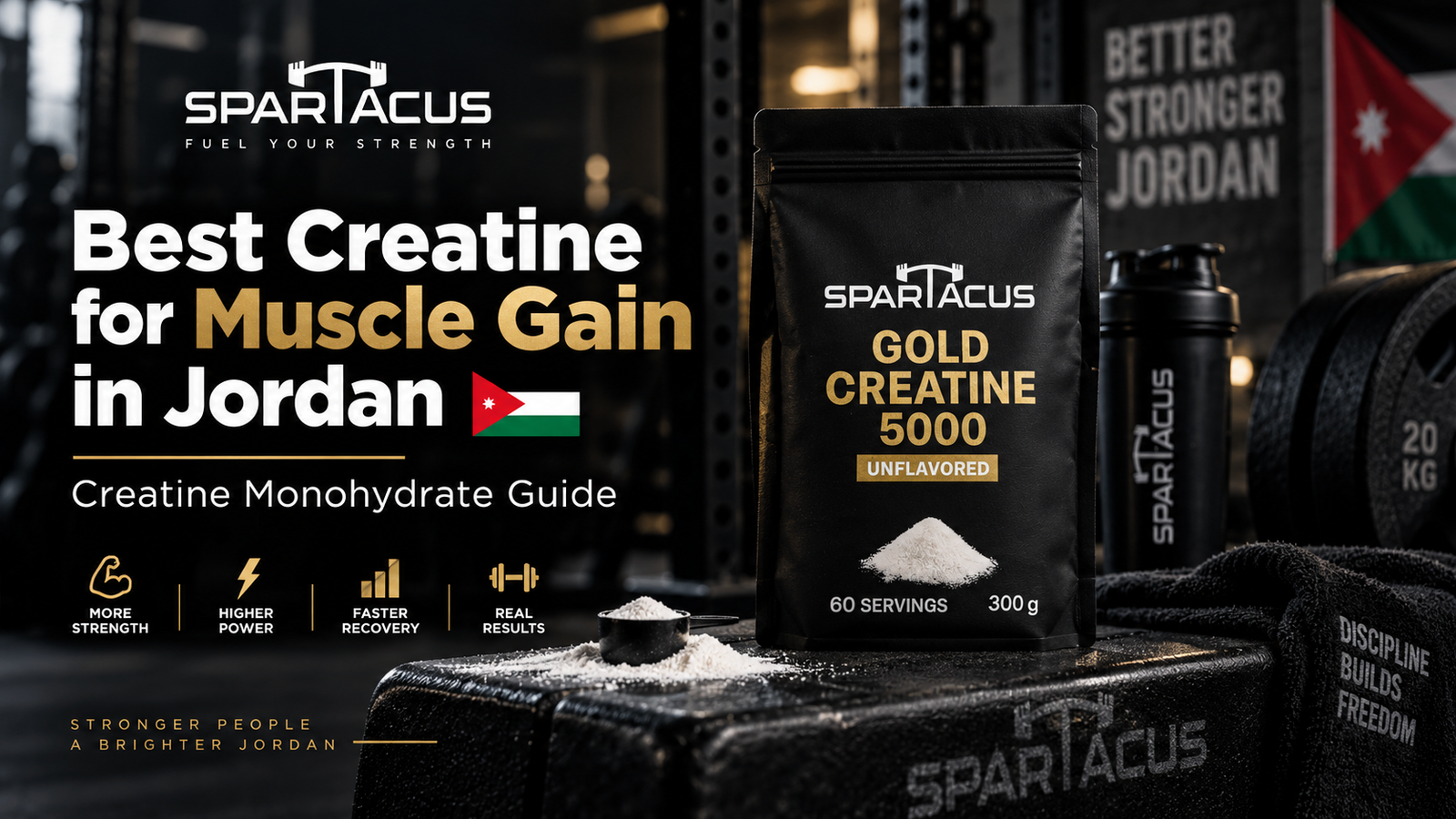
If you are looking for the best creatine for muscle gain in Jordan, the most important thing is not finding the most complicated formula. For most people, creatine monohydrate is the simplest and most widely studied form.
Creatine can support strength, power and repeated high-intensity exercise, which may help you train more effectively over time. However, creatine does not replace resistance training, adequate protein, enough calories or recovery.
If you want a broader overview of creatine products and selection criteria, read our guide to Best Creatine in Jordan.
How Does Creatine Help With Muscle Gain?
Creatine is stored mainly in skeletal muscle, where it helps support the production of energy during short, intense efforts such as weight training, sprinting and repeated high-intensity exercise.
Supplementing with creatine can increase muscle creatine stores and may improve strength, power and training capacity. Over time, this can help support the training stimulus needed for muscle growth.
The key point is:
Creatine supports the training process that contributes to muscle gain. It does not build muscle by itself.
For muscle growth, you still need:
- Progressive resistance training
- Adequate daily protein
- Enough calories
- Good sleep
- Recovery
- Consistency
What Is the Best Creatine for Muscle Gain?
For most healthy adults, creatine monohydrate is the most established option.
It is the most widely used and researched form of creatine, while more expensive alternative forms have not consistently been shown to outperform creatine monohydrate for increasing muscle creatine levels or performance.
When choosing creatine for muscle gain, look for:
- Creatine monohydrate clearly listed on the label
- Transparent serving information
- A practical daily dose
- Simple ingredients
- Clear product information
- Consistent quality
You generally do not need a complicated creatine blend simply because your goal is muscle growth.
Creatine Monohydrate vs Other Forms
You may see products containing:
- Creatine HCL
- Buffered creatine
- Creatine ethyl ester
- Creatine blends
- Micronized creatine
Different forms are available, but creatine monohydrate remains the most extensively researched.
For most people trying to build muscle, choosing a straightforward creatine monohydrate product is a practical place to start.
How Much Creatine Should You Take for Muscle Gain?
A commonly used maintenance intake is:
3–5 grams of creatine monohydrate per day
This is the range commonly used after loading protocols and is also used as a daily approach without loading.
For most people, consistency matters more than continually changing the dose.
Spartacus Gold Creatine 5000 provides 5 g of creatine per serving.
That places one serving within the commonly used daily maintenance range.
Do You Need a Creatine Loading Phase?
No.
A loading phase is optional.
A traditional loading approach often uses approximately 20 g per day for 5–7 days, divided into smaller servings, followed by around 3–5 g per day.
However, another approach is simply to take approximately 3–5 g per day consistently. Muscle creatine stores can still increase over time without a loading phase.
For many people, the daily approach is simpler.
Should You Take Creatine Every Day for Muscle Gain?
Creatine is generally taken consistently.
That means taking it on:
- Training days
- Rest days
The goal is to maintain increased muscle creatine stores rather than use creatine only immediately before a workout.
A simple routine is often more useful than worrying about perfect timing.
Creatine Before or After Workout for Muscle Gain?
Creatine can be taken before or after training.
Exact timing is generally less important than consistent daily intake.
If taking it after training makes it easier to remember, that can be a practical routine.
For a more detailed explanation, read:
Creatine Before or After Workout?
Can You Take Creatine With Whey Protein?
Yes.
Creatine and whey protein serve different purposes.
Creatine supports muscle creatine stores and high-intensity training performance.
Whey protein helps you increase your daily protein intake.
Using them together can make sense in a muscle-building nutrition plan.
For example, you can add your creatine serving to a post-workout whey protein shake if that is convenient for you.
Read more in our guide:
Creatine and Whey Protein Together
How Much Protein Do You Need When Using Creatine?
Creatine cannot compensate for insufficient protein intake.
People doing resistance training generally need more protein than inactive individuals. The NIH notes that athletes commonly require approximately 1.2–2.0 g of protein per kilogram of body weight per day, depending on training and overall nutrition.
For example, an 80 kg person might consume approximately:
96–160 g of protein per day
depending on their goals, training programme and nutrition plan.
Creatine should be used alongside an adequate diet rather than as a replacement for it.
Do You Need a Calorie Surplus to Gain Muscle?
Muscle gain is strongly influenced by your overall energy intake.
If your goal is to gain size, you need to make sure your total diet provides enough energy to support training and recovery.
Creatine can support your performance, but it cannot compensate for consistently eating too little.
Your muscle-building plan should consider:
- Total calories
- Protein
- Carbohydrates
- Dietary fats
- Training volume
- Recovery
Does Creatine Directly Increase Muscle Size?
Creatine may influence scale weight and muscle appearance in more than one way.
One early change can come from increased water stored inside muscle cells.
Over longer periods, creatine may also help support better training performance, which can contribute to training adaptations when combined with resistance exercise.
NIH guidance notes that creatine often causes some weight gain because of increased water retention and that supplementation can support adaptations to training.
Does Creatine Cause Weight Gain?
It can cause an increase in body weight.
However, this does not automatically mean fat gain.
Creatine increases water storage in muscle cells, which can contribute to an increase on the scale.
For a more detailed explanation, read:
Does Creatine Cause Weight Gain?
Is Creatine Good for Bulking?
Creatine can be useful during a bulking phase because bulking usually includes:
- Progressive strength training
- Higher training volume
- Adequate calories
- Adequate protein
Creatine may support repeated high-intensity training and strength, making it a relevant supplement for people trying to gain muscle during a structured bulking programme.
However, creatine is not a mass gainer.
It does not provide a significant number of calories.
If you struggle to gain weight because you are not eating enough, you may also need to review your overall calorie intake.
Can You Use Creatine While Cutting?
Yes.
Creatine can also be used during a cutting phase.
The goal during a calorie deficit is usually to reduce body fat while maintaining as much strength and lean mass as possible.
Because creatine can support high-intensity training performance, some people continue using it while cutting.
Any scale increase caused by water stored in muscle should not automatically be confused with fat gain.
Creatine for Strength and Muscle Gain
One of creatine’s strongest applications is repeated short-duration, high-intensity exercise.
This includes resistance training.
Studies summarized by the NIH show that creatine supplementation can improve strength, power and repeated maximal-effort performance, although individual responses vary.
This is why creatine is commonly used by:
- Gym-goers
- Bodybuilders
- Strength athletes
- People following hypertrophy programmes
- Athletes who perform repeated explosive efforts
How Long Does Creatine Take to Work?
The answer depends partly on how you use it.
With a loading phase, muscle creatine stores can increase faster.
Without loading, taking a consistent daily amount can gradually increase muscle creatine stores over several weeks.
You should not expect creatine to feel like a stimulant or pre-workout.
Its benefits come mainly from maintaining increased muscle creatine stores.
How Long Should You Take Creatine?
Creatine is commonly used continuously rather than in short cycles.
Research summarized by the NIH indicates that creatine has been studied for both short-term and longer-term use in healthy adults.
There is generally no need to stop and restart creatine every few weeks simply because you have been using it consistently.
Anyone with a medical condition, taking medications, pregnant or breastfeeding, or unsure whether supplementation is appropriate should consult a qualified healthcare professional.
Common Mistakes When Using Creatine for Muscle Gain
Expecting creatine to replace training
Creatine supports your training. It does not replace progressive resistance exercise.
Taking creatine only on workout days
Consistency is generally more important than using it only immediately around training.
Ignoring protein intake
Creatine does not replace dietary protein.
Ignoring calories
If you are trying to gain size but consistently eat too little, progress may be limited.
Taking excessive amounts
More does not automatically mean better.
A simple daily maintenance amount is enough for many users.
Expecting instant muscle growth
Creatine is not a shortcut.
Training, nutrition and consistency remain the foundations of muscle gain.
Spartacus Gold Creatine 5000 for Muscle Gain
For people looking for a straightforward creatine option in Jordan, Spartacus Gold Creatine 5000 provides:
5 g of creatine per serving
and:
60 servings per pack
A 5 g serving fits within the commonly used daily maintenance range for creatine.
For muscle gain, it can be incorporated alongside:
- Progressive resistance training
- Adequate protein
- Sufficient calories
- Recovery
- Consistent daily supplementation
Frequently Asked Questions
What is the best creatine for muscle gain in Jordan?
For most people, creatine monohydrate is the simplest and most widely researched form to consider.
How much creatine should I take for muscle gain?
A commonly used maintenance amount is approximately 3–5 g per day.
Is 5 g of creatine enough for muscle gain?
For many adults, 5 g falls within the commonly used daily maintenance range.
Should I take creatine every day?
Creatine is commonly taken daily, including on rest days.
Should I take creatine before or after training?
Either can work. Consistent daily intake is generally more important than the exact timing.
Can I take creatine and whey protein together?
Yes. Creatine and whey protein perform different roles and can be used together.
Does creatine make you gain fat?
Creatine itself does not automatically cause fat gain. An early increase in body weight may be related to increased water stored in muscle.
Is creatine good for bulking?
Creatine can support strength and high-intensity training during a bulking programme, but adequate calories and protein are still essential.
Can I use creatine while cutting?
Yes. Creatine can continue to support high-intensity training while you are in a calorie deficit.
How long does creatine take to work?
A loading phase can increase muscle creatine stores more quickly. Without loading, consistent daily use can build stores gradually over several weeks.
Final Thoughts: Best Creatine for Muscle Gain in Jordan
Choosing the best creatine for muscle gain in Jordan does not need to be complicated.
For most people, the main priorities are:
- Choose creatine monohydrate
- Take approximately 3–5 g daily
- Use it consistently
- Train progressively
- Consume enough protein
- Eat enough calories for your goal
- Prioritize recovery and sleep
Spartacus Gold Creatine 5000 provides 5 g of creatine per serving and 60 servings per pack, making it a straightforward option for people who want to include creatine in a structured muscle-building programme.