


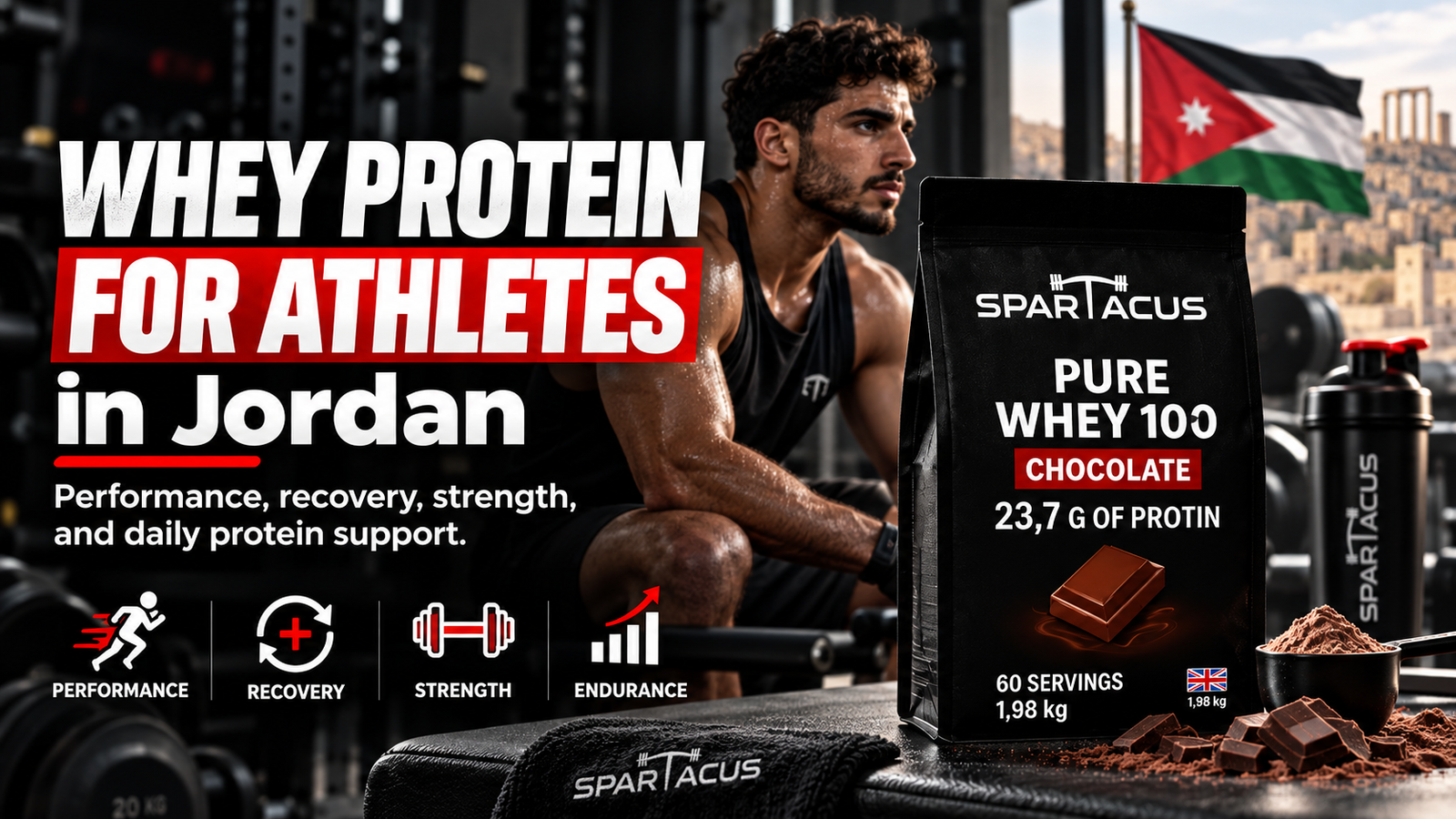
If you are looking for whey protein for athletes in Jordan, the first thing to understand is that athletes do not need protein simply because they train hard.
They need enough protein because regular training increases the importance of:
- Muscle repair
- Adaptation
- Recovery
- Maintaining lean mass
- Supporting repeated training sessions
Whey protein can make it easier to reach daily protein needs, especially when normal meals are not enough.
But it should remain part of a complete sports nutrition plan that also includes carbohydrates, fats, hydration, sleep and sufficient calories.
Why Do Athletes Need Protein?
Training creates stress on muscle tissue.
Your body responds by repairing and adapting to that training.
Protein provides amino acids that contribute to:
- Muscle repair
- Muscle protein synthesis
- Maintaining muscle mass
- Adaptation to resistance training
- Recovery after exercise
Athletes usually need to think about total daily protein rather than focusing only on one post-workout shake.
Is Whey Protein Good for Athletes?
Yes.
Whey protein is commonly used by athletes because it is:
- High in protein
- Convenient
- Easy to prepare
- Rich in essential amino acids
- Relatively fast-digesting
- Easy to use around training
However, whey protein does not replace a balanced diet.
Athletes still need enough:
protein + carbohydrates + fats + fluids + micronutrients + calories
How Much Protein Do Athletes Need?
Protein requirements depend on factors such as:
- Body weight
- Sport
- Training volume
- Training intensity
- Age
- Calorie intake
- Goal
- Recovery demands
Sports nutrition guidance commonly places protein needs for exercising individuals around 1.4–2.0 g per kilogram of body weight per day, depending on the training context. Spartacus Protein
For example:
A 75 kg athlete might consume approximately:
105–150 g of protein per day
depending on their sport and nutrition plan.
Whey protein can help fill part of this requirement.
It does not need to supply all of it.
How Much Whey Protein Should an Athlete Take?
There is no universal number of scoops.
The correct amount depends on how much protein the athlete already gets from food.
For example, if meals provide almost all daily protein needs, one shake may be enough.
If food intake consistently falls short, additional whey may be useful.
Spartacus Pure Whey 100 Chocolate currently provides approximately 23.7 g of protein per serving. Spartacus Protein
The better question is:
How much protein is missing from your daily diet?
Then use whey only to help close that gap.
Whey Protein for Strength Athletes
Strength-focused athletes may use whey to support daily protein intake during programmes involving:
- Heavy resistance training
- Powerlifting
- Strength training
- Olympic lifting
- Repeated high-intensity sessions
Protein is particularly important when training volume is high.
But strength progress still depends on:
training + calories + protein + recovery + sleep + consistency
Whey supports the protein side of that equation.
Whey Protein for Endurance Athletes
Endurance athletes also need protein.
Running, cycling and other endurance training can create recovery demands even when muscle gain is not the primary goal.
Protein may help support:
- Muscle repair
- Recovery
- Maintenance of lean mass
- Adaptation to training
However, endurance athletes also need adequate carbohydrates.
Whey protein should not replace carbohydrate intake around long or demanding endurance sessions.
Whey Protein for Team-Sport Athletes
Team sports often combine:
- Running
- Sprinting
- Strength
- Power
- Repeated high-intensity efforts
Athletes involved in football, basketball and similar sports may benefit from spreading protein intake across the day.
A whey shake can be practical when:
- Training finishes late
- Food is not immediately available
- Multiple sessions occur in one day
- Travel makes regular meals difficult
Whey Protein Before Training
You can consume whey before training.
This may be useful if:
- Your previous meal was several hours earlier
- You need a convenient protein source
- A full meal feels too heavy
A light whey shake may be easier to tolerate than a large meal close to training.
But athletes should also consider whether they need carbohydrates before exercise.
Protein alone is not always enough to fuel demanding sessions.
Whey Protein After Training
Post-workout whey is popular because it is convenient.
After training, whey can help athletes begin meeting their protein needs without waiting for a full meal.
However, you do not need to drink it within a few minutes of finishing exercise.
Your overall daily protein intake remains the bigger priority.
If a normal protein-rich meal is available soon after training, a shake may not be necessary.
Whey Protein Between Training Sessions
Athletes who train more than once per day may find whey useful between sessions.
For example:
Morning training → meal → whey shake → evening training
This can make it easier to distribute protein intake across the day.
But recovery between sessions also requires attention to:
- Carbohydrates
- Fluids
- Electrolytes
- Calories
- Rest
Whey protein is only one component.
Whey Protein on Rest Days for Athletes
Athletes can use whey on rest days.
Recovery continues even when there is no scheduled training session.
Your protein needs do not disappear on rest days.
But whey is still optional.
If your meals already provide enough protein, you do not need to force another shake.
Whey Protein for Muscle Recovery
Whey protein can help athletes meet the protein intake needed to support recovery after training.
It does not instantly repair muscle.
Recovery still depends heavily on:
sleep + calories + protein + hydration + training management
Spartacus already has a dedicated Whey Protein for Recovery in Jordan guide that can be linked naturally here. Spartacus Protein
Whey Protein and Carbohydrates for Athletes
Protein and carbohydrates serve different purposes.
Protein
Primarily helps support:
- Muscle repair
- Muscle maintenance
- Adaptation
Carbohydrates
Primarily help support:
- Training energy
- Glycogen stores
- High-volume training
- Repeated exercise performance
Athletes should avoid treating whey protein as a complete sports nutrition strategy by itself.
Whey Protein With Milk or Water for Athletes
Both can work.
Water
May be useful when you want:
- Lower calories
- A lighter shake
- Faster preparation
- Easier digestion
Milk
May be useful when you want:
- Additional calories
- Extra protein
- Carbohydrates
- A more filling shake
The better choice depends on the athlete’s goal.
Can Athletes Take Whey Protein Every Day?
Yes, if it fits their overall protein needs and diet.
There is no requirement to cycle whey protein.
It is simply a food-derived protein supplement.
The important question is whether the athlete needs it.
If daily meals already provide sufficient protein, whey may not be necessary every day.
Can Athletes Take Whey Protein Twice a Day?
Yes.
Two shakes can be used if they help meet total protein needs.
But two shakes are not automatically better than one.
Whole foods should still provide a large part of the athlete’s nutrition.
Spartacus already has a detailed guide on Can You Take Whey Protein Twice a Day?
Whey Protein and Creatine for Athletes
Whey protein and creatine can be used together.
They serve different purposes.
Whey protein helps increase dietary protein intake.
Creatine can help increase muscle creatine stores and support repeated high-intensity exercise.
Athletes involved in strength, power or repeated sprint activity may use both within the same programme.
Does Whey Protein Help Athletic Performance?
Whey protein is not a stimulant.
You should not expect an immediate performance boost after drinking one shake.
Its value comes mainly from helping you consistently meet protein needs.
Over time, good nutrition can support:
- Recovery
- Adaptation
- Maintaining muscle
- Training consistency
Performance still depends on the complete training and nutrition system.
Does Whey Protein Help Endurance?
Whey protein is not an endurance fuel in the same way carbohydrates are.
For endurance exercise, carbohydrates are usually more important for immediate energy.
Protein can still help with recovery and muscle maintenance.
Endurance athletes should therefore avoid replacing essential carbohydrate intake with excessive protein.
Whey Protein for Athletes During Cutting
Athletes reducing body fat may find whey especially useful.
When calories are lower, whey can provide protein without requiring a very large meal.
This may help support muscle retention.
But fat loss still depends mainly on maintaining an appropriate calorie deficit.
The existing Whey Protein for Weight Loss in Jordan guide covers this topic in more detail. Spartacus Protein
Whey Protein for Athletes During Bulking
Athletes trying to gain weight can also use whey.
However, whey mainly provides protein.
If the bigger challenge is total calorie intake, athletes may need:
- Larger meals
- More carbohydrates
- Healthy fats
- Higher-calorie shakes
- A mass gainer in some situations
The goal determines the best option.
Spartacus Pure Whey 100 for Athletes
For athletes in Jordan looking for a convenient whey protein option, Spartacus Pure Whey 100 Chocolate currently provides approximately:
- 23.7 g protein per serving
- 60 servings
- WPC 80 whey protein concentrate
It can be used:
- After training
- Between meals
- On busy training days
- On rest days if additional protein is needed
- In higher-calorie shakes when appropriate Spartacus Protein
Common Mistakes Athletes Make With Whey Protein
Replacing Too Many Meals
Whey protein should supplement a balanced diet rather than replace most normal food.
Ignoring Carbohydrates
Athletes still need carbohydrates, especially for demanding training.
Taking More Protein Than Needed
More protein does not automatically equal more performance.
Ignoring Total Calories
Athletes need enough overall energy to train and recover.
Relying Only on Post-Workout Protein
Daily protein distribution matters more than one single shake.
Ignoring Hydration
Protein intake cannot compensate for poor hydration.
Frequently Asked Questions
Is whey protein good for athletes?
Yes. Whey can help athletes meet daily protein needs in a convenient way.
How much protein does an athlete need?
Needs vary, but sports nutrition guidance often places exercising individuals around 1.4–2.0 g/kg/day, depending on training and goals.
When should athletes take whey protein?
Whey can be taken before training, after training, between meals or at another convenient time.
Should athletes drink whey after every workout?
Not necessarily. It is useful when it helps you meet your daily protein target.
Can endurance athletes take whey protein?
Yes. Endurance athletes also need protein, although carbohydrates remain particularly important for training energy.
Can athletes take whey every day?
Yes, if it fits their overall diet and protein requirement.
Can athletes take whey twice a day?
Yes, when needed to meet daily protein intake.
Can athletes take whey and creatine together?
Yes. They serve different roles and can be used in the same nutrition programme.
Final Thoughts: Whey Protein for Athletes in Jordan
Whey protein can be a useful tool for athletes, but it should not be treated as a complete performance solution.
The bigger picture is:
training + protein + carbohydrates + calories + hydration + sleep + recovery
Whey protein mainly makes it easier to reach your daily protein target.
For athletes in Jordan, Spartacus Pure Whey 100 Chocolate provides approximately 23.7 g of protein per serving and can be incorporated around training, between meals or at other times when additional protein is needed.