


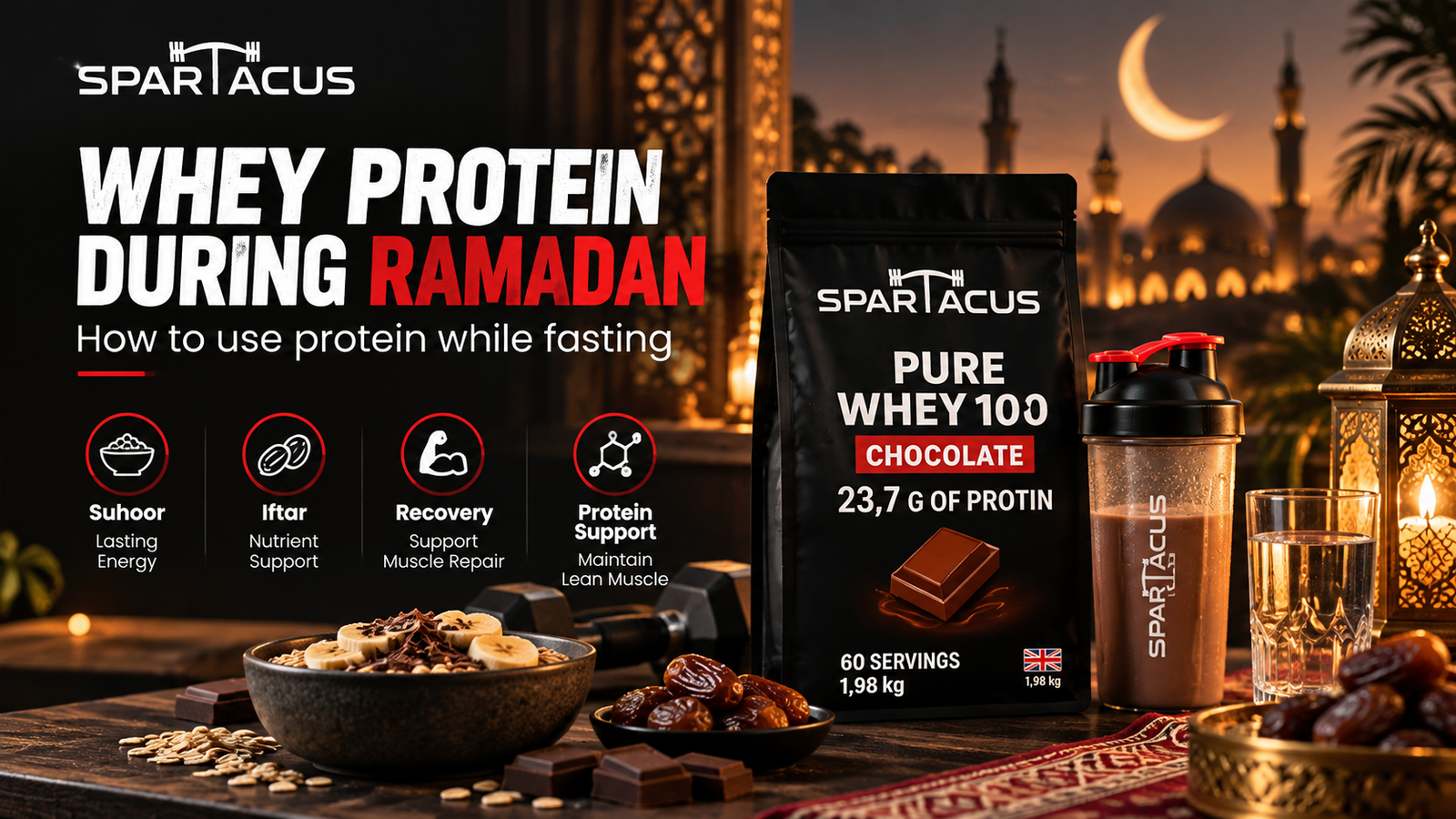
If you are wondering how to use whey protein during Ramadan, the main goal is simple:
Maintain enough daily protein while adapting your eating schedule to the hours between iftar and suhoor.
During Ramadan, fasting changes:
- Meal timing
- Fluid intake
- Training timing
- Sleep
- Recovery
- Total calorie intake
For active people and athletes, these changes can make it harder to distribute protein across the day.
Whey protein can be useful because it provides a convenient source of high-quality protein during the non-fasting hours.
However, whey protein does not replace normal meals.
It should support a complete nutrition plan.
Can You Take Whey Protein During Ramadan?
Yes.
Whey protein can be consumed during Ramadan during the hours when eating and drinking are allowed.
That generally means between:
iftar and suhoor
You can take whey:
- At iftar
- After training
- Between evening meals
- Before bed
- At suhoor
The best option depends on your training schedule and how much protein you already get from food.
Why Protein Matters During Ramadan
Protein remains important during Ramadan because the body still needs amino acids for:
- Muscle repair
- Muscle maintenance
- Training adaptation
- Recovery
- Normal body functions
For athletes, maintaining adequate energy and macronutrient intake during Ramadan can help reduce performance declines. Reviews of Ramadan fasting in athletes emphasize the importance of maintaining protein, carbohydrates, hydration, and sleep as much as possible.
Does Fasting Cause Muscle Loss?
Fasting during Ramadan does not automatically cause muscle loss.
The bigger risks usually come from:
- Eating too few calories
- Consuming too little protein
- Reducing resistance training too much
- Poor recovery
- Poor sleep
Athletes who maintain their overall nutrition, training load, and sleep are less likely to experience meaningful reductions in performance or body composition.
Protein intake is therefore one part of protecting muscle during Ramadan.
Is Whey Protein Good During Ramadan?
Yes.
Whey protein can be particularly useful because it is:
- High in protein
- Convenient
- Quick to prepare
- Easy to add between meals
- Practical after training
This can matter during Ramadan because the eating window is shorter.
Instead of relying on two very large meals, whey protein can help distribute protein across the evening.
Whey Protein at Iftar
You can take whey protein at iftar.
However, it does not always need to be the first thing you consume.
A typical iftar may already include:
- Water
- Dates
- Soup
- Rice
- Meat or chicken
- Yogurt
- Other foods
If your iftar already contains enough protein, you may not need a whey shake immediately.
You can save it for later in the evening or after training.
Whey Protein After Training During Ramadan
This is one of the most practical times to use whey protein.
If you train after iftar, a whey shake afterward can help provide protein for recovery.
A simple post-training option could include:
whey protein + water or milk + banana or another carbohydrate source
Protein supports muscle repair, while carbohydrates help replenish glycogen used during training.
Sports nutrition guidance for Ramadan emphasizes post-exercise nutrition and adequate protein intake during the nighttime feeding period.
Whey Protein at Suhoor
Yes, you can take whey protein at suhoor.
This may be useful if:
- Your suhoor is low in protein
- You struggle to eat enough solid food
- You want to increase daily protein intake
- You train regularly
However, suhoor should not consist only of a whey shake.
A more balanced suhoor may include:
- Whey protein
- Oats
- Milk or yogurt
- Eggs
- Bread
- Fruit
- Healthy fats
- Fluids
This gives you more than protein alone.
Is Whey Protein Better at Iftar or Suhoor?
Neither is automatically better.
The better time is the one that helps you reach your daily protein target.
For example:
If you train after iftar
A whey shake after training may be convenient.
If you struggle to eat enough at suhoor
Whey may help increase protein intake.
If your meals already contain plenty of protein
You may not need whey at either meal.
Daily intake matters more than one exact timing choice.
How Much Protein Do You Need During Ramadan?
Protein needs depend on:
- Body weight
- Training volume
- Goal
- Age
- Total calorie intake
- Whether you are trying to gain, maintain, or lose weight
For active people, sports nutrition recommendations commonly emphasize maintaining adequate protein intake throughout Ramadan rather than letting it fall because of the shorter eating window.
The key is to spread protein across the available meals rather than eating almost all of it at once.
How Much Whey Protein Should You Take?
You do not need a special Ramadan dose.
A typical serving should simply help you meet your daily protein needs.
Spartacus Pure Whey 100 Chocolate provides approximately 23.7 g of protein per serving.
That can fit well into:
- Post-training nutrition
- Evening snacks
- Suhoor
- A protein shake between meals
Should You Take Whey Protein Every Day During Ramadan?
You can, but you do not have to.
Whey protein is useful when it helps fill a protein gap.
If you already get enough protein from food such as:
- Chicken
- Meat
- Fish
- Eggs
- Milk
- Yogurt
- Cheese
- Legumes
then whey is optional.
Whey Protein and Hydration During Ramadan
Hydration becomes especially important during Ramadan because fluids cannot be consumed during daylight fasting hours.
Whey protein itself does not replace water.
Try to spread fluid intake between:
- Iftar
- Evening meals
- Around training
- Before bed
- Suhoor
Ramadan sports-nutrition guidance consistently highlights nighttime hydration and electrolyte intake as important for athletes.
Should You Mix Whey With Water or Milk During Ramadan?
Either can work.
Whey With Water
May be useful if you want:
- Fewer calories
- A lighter shake
- Faster preparation
Whey With Milk
Adds:
- More protein
- More calories
- Carbohydrates
- Calcium
The better choice depends on your goal.
If you are trying to gain weight, milk may be useful.
If you are managing calories, water may be more practical.
Whey Protein After Training Before Iftar
If you train before iftar, you cannot drink whey protein until the fast ends.
That is fine.
You do not need to consume protein immediately after your final set.
If training finishes close to iftar, you can take whey or eat a protein-containing meal once the fast is broken.
Research on Ramadan training suggests that scheduling exercise near iftar can make post-exercise nutrition and hydration easier.
Whey Protein After Iftar Training
Training after iftar often gives you more flexibility.
You can:
- Drink before training
- Eat beforehand
- Consume whey afterward
- Rehydrate normally
For many active people, this can make recovery easier.
Whey Protein Before Training During Ramadan
You can take whey protein before training if you are training during the non-fasting period.
For example:
iftar → light meal → training → post-workout meal
or
iftar → whey shake → training later
The choice depends on digestion and comfort.
Whey Protein During Night Training
Some people train late at night during Ramadan.
A whey shake can be useful afterward if:
- You do not want a very heavy meal
- Your protein intake is still low
- You plan to sleep soon
However, you still need adequate calories and carbohydrates if training volume is high.
Whey Protein Before Bed During Ramadan
Yes.
Whey protein can be taken before bed.
There is no rule saying whey cannot be consumed at night.
If it helps you reach your daily protein target, it can be useful.
Whey Protein for Muscle Maintenance During Ramadan
This is one of the main reasons active people may use whey during Ramadan.
Protein helps support lean mass when:
- Calories are lower
- Meal frequency is reduced
- Training continues
- Weight loss occurs
But protein is only part of the picture.
Muscle maintenance also depends on:
resistance training + adequate calories + sleep + recovery
Whey Protein for Weight Loss During Ramadan
Some people lose weight during Ramadan.
Whey protein may help by:
- Increasing protein intake
- Supporting muscle maintenance
- Making meals more filling
- Providing a convenient protein source
But whey protein does not automatically cause fat loss.
Fat loss still depends on overall calorie balance.
Whey Protein for Muscle Gain During Ramadan
It is still possible to support muscle gain during Ramadan, but it may be harder if total calorie intake drops significantly.
If your goal is muscle gain, focus on:
- Enough protein
- Enough calories
- Strength training
- Carbohydrates
- Sleep
- Consistency
Whey protein can help with protein intake, but it cannot replace a calorie-surplus diet.
Whey Protein and Carbohydrates During Ramadan
Protein and carbohydrates play different roles.
Protein
Supports:
- Muscle repair
- Muscle maintenance
- Adaptation
Carbohydrates
Support:
- Glycogen
- Training energy
- Recovery
- High-intensity performance
Ramadan sports-nutrition guidance highlights both carbohydrate and protein intake as important for athletes.
Whey Protein and Creatine During Ramadan
Whey protein and creatine can be used together.
They do different things.
Whey Protein
Helps provide dietary protein.
Creatine
Helps support muscle creatine stores and high-intensity performance.
You can take both during the non-fasting hours.
Whey Protein and Sleep During Ramadan
Sleep can become disrupted because of:
- Late meals
- Training
- Suhoor
- Early waking
- Social schedules
Poor sleep can affect:
- Recovery
- Training quality
- Hunger
- Energy
Protein cannot compensate for consistently poor sleep.
Ramadan reviews have identified changes in sleep as an important factor affecting athletes and active people.
Whey Protein During Ramadan for Beginners
Beginners do not need a complicated plan.
A simple approach may be:
Iftar: protein-rich meal
After training: whey protein if needed
Evening: normal meal or snack
Suhoor: another protein-containing meal
The goal is simply to reach a reasonable daily protein intake.
Whey Protein During Ramadan for Women
Women can use whey protein during Ramadan for the same basic reasons:
- Daily protein intake
- Recovery
- Muscle maintenance
- Training support
Protein needs depend more on factors such as body size, activity level, goals, and total diet than on gender alone.
Spartacus Pure Whey 100 During Ramadan
For people in Jordan who want a convenient protein option during Ramadan, Spartacus Pure Whey 100 Chocolate provides approximately:
- 23.7 g protein per serving
- Whey protein concentrate
- A convenient shake format
It can be used:
- After training
- Between iftar and suhoor
- At suhoor
- Before bed
- As part of an evening meal
The important point is to use it as part of your total daily nutrition plan.
Example Ramadan Protein Schedule
A simple example could look like this:
Iftar
Water + dates + balanced meal with a protein source
Later in the Evening
Training
After Training
Whey protein + carbohydrate source
Before Bed
Protein-containing snack if needed
Suhoor
Eggs, yogurt, milk, oats, bread, or another protein-rich meal
This is only an example.
Your actual plan should depend on your training schedule and individual needs.
Common Mistakes With Whey Protein During Ramadan
Relying Only on Protein Shakes
Whey should support your diet, not replace meals.
Eating Too Little Protein Overall
Two large meals do not always guarantee enough protein.
Ignoring Hydration
Fluid intake is especially important during the nighttime window.
Ignoring Carbohydrates
Athletes still need fuel for training.
Taking Too Many Shakes
More whey does not automatically mean better results.
Ignoring Calories
Muscle gain and recovery still require enough total energy.
Ignoring Sleep
Poor sleep can make recovery harder.
Frequently Asked Questions
Can I take whey protein during Ramadan?
Yes. Take it during the non-fasting hours between iftar and suhoor.
What is the best time to take whey protein during Ramadan?
There is no single best time. After training, between meals, before bed, or at suhoor can all work.
Can I take whey protein at suhoor?
Yes.
Can I take whey protein at iftar?
Yes.
Is whey protein good after training during Ramadan?
Yes. It can help provide protein for recovery after training.
Can whey protein help prevent muscle loss during Ramadan?
Adequate protein can support muscle maintenance, but training, calories, sleep, and recovery also matter.
Can I take whey protein with creatine during Ramadan?
Yes.
Should I mix whey with milk or water?
Both can work. Choose based on your calorie needs, digestion, and preference.
How much whey protein should I take during Ramadan?
Use enough to help meet your daily protein target. One normal serving may be enough for many people.
Do I need whey protein every day?
No. Use it when it helps fill a protein gap in your diet.
Final Thoughts: Whey Protein During Ramadan
Using whey protein during Ramadan can be a practical way to maintain protein intake when meal timing is limited.
The most important priorities remain:
total daily protein + enough calories + carbohydrates + hydration + sleep + sensible training
Whey protein can fit naturally into the hours between iftar and suhoor.
For people in Jordan, Spartacus Pure Whey 100 Chocolate provides approximately 23.7 g of protein per serving and can be used after training, between meals, before bed, or at suhoor depending on your needs.