


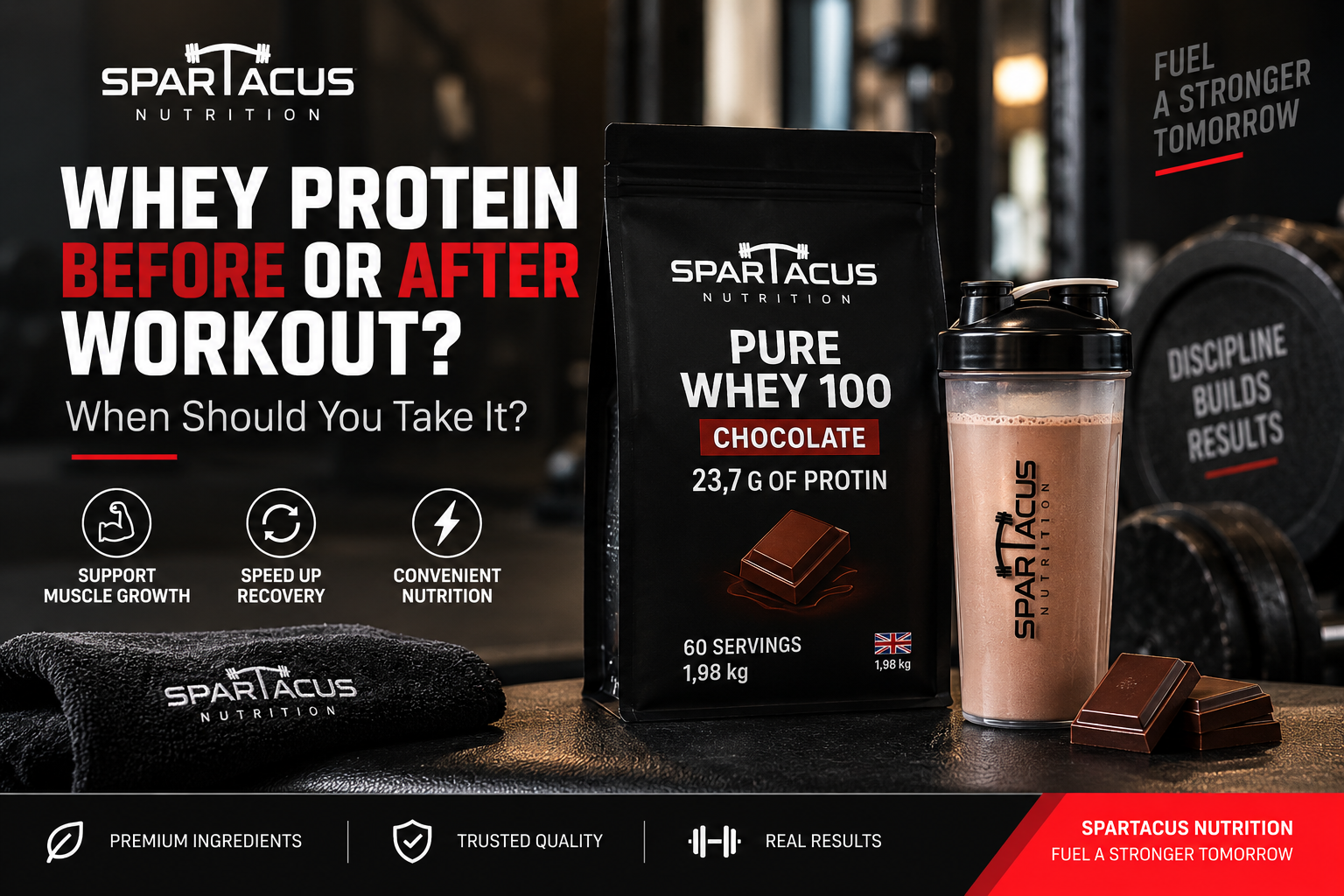
Whey protein before or after workout is one of the most common questions among people using protein supplements to support muscle growth and recovery.
The short answer is simple: either can work.
For most people, meeting their total daily protein requirement is more important than drinking a protein shake at one exact moment. However, taking whey protein around your workout can be a convenient way to distribute protein throughout the day and support your nutrition around training.
So, is whey protein better before or after your workout?
In this guide, we’ll explain protein timing, what matters most for building muscle, and how to decide when to take your whey protein based on your training schedule and meals.
What Is Whey Protein?
Whey protein is a high-quality protein derived from milk.
It provides all nine essential amino acids, including the branched-chain amino acids (BCAAs) needed as part of the body’s process of building and repairing muscle proteins.
Whey is also popular among athletes and gym-goers because it provides a convenient way to increase daily protein intake without preparing another full meal.
The important point is that whey protein is a source of dietary protein — not simply a post-workout supplement.
You can use it at different times of the day depending on your diet, training schedule and protein requirements.
Should You Take Whey Protein Before or After Workout?
You can take whey protein before or after your workout.
Neither option is automatically right for everyone.
What matters more is whether you are consuming enough protein throughout the day and distributing that protein sensibly across your meals.
If you have already eaten a protein-rich meal relatively close to your workout, there may be less urgency to drink a whey protein shake immediately afterward.
On the other hand, if you trained several hours after your last protein-containing meal, having whey protein after training can be a practical way to get protein into your next meal or snack.
Instead of thinking:
“I must drink whey protein immediately after training.”
A better question is:
“Am I getting enough high-quality protein throughout the day, including around my training?”
Whey Protein Before Workout
Taking whey protein before training can be useful when your previous meal was several hours earlier.
For example, someone training in the afternoon might have lunch several hours before entering the gym. A whey protein shake before training can provide a convenient source of protein without requiring another large meal.
Potential advantages of whey protein before training
Taking whey protein before your workout may help you:
- Add protein to your daily intake
- Avoid training after a long period without protein
- Distribute protein more evenly throughout the day
- Get a convenient protein source when a full meal is impractical
However, you don’t need to force yourself to drink whey immediately before training.
Some people prefer exercising without a shake or large amount of food in their stomach.
Your overall diet and personal comfort matter.
Whey Protein After Workout
Taking whey protein after training is probably the most familiar approach.
Resistance training provides a stimulus for muscle adaptation, while dietary protein provides amino acids that the body can use as part of muscle protein synthesis and recovery.
Whey protein can therefore be a convenient post-workout option.
Potential advantages of whey protein after training
A post-workout whey shake can:
- Provide high-quality protein
- Help you reach your daily protein target
- Provide essential amino acids
- Fit conveniently between training and your next full meal
- Make post-workout nutrition easier when you cannot eat immediately
For many people, this is simply the easiest time to remember to take their protein.
That convenience can help with consistency.
Is There Really a 30-Minute “Anabolic Window”?
You’ve probably heard that you need to consume protein within 30 minutes after your workout or you will miss your opportunity to build muscle.
The reality is more flexible.
Research on nutrient timing does not support treating the post-workout period as an extremely narrow window where a protein shake must be consumed immediately.
According to the International Society of Sports Nutrition, protein intake around resistance exercise can support muscle protein synthesis, while total daily protein intake remains an important consideration.
A widely cited review of protein timing found that total protein intake is an important factor when evaluating the relationship between protein timing and resistance-training adaptations.
That doesn’t mean post-workout protein is useless.
It means you generally don’t need to panic if you cannot drink your shake the moment your final set ends.
Your meals before and after training, total daily protein intake and overall training program all matter.
What Matters More Than Protein Timing?
For most people trying to build muscle, several factors deserve more attention than whether their shake is consumed at 5:00 PM or 5:45 PM.
1. Total daily protein intake
First, make sure you’re consuming enough protein across the entire day.
If you consistently consume too little protein, perfect supplement timing will not compensate for the overall shortage.
If you’re unsure about your target, read our guide:
How Much Protein Do You Need to Build Muscle? A Practical Guide
2. Protein quality
Protein quality also matters.
Whey is considered a complete protein because it provides all essential amino acids.
That makes it a useful option for supplementing a diet that already contains protein-rich foods.
3. Protein distribution
Rather than consuming almost all of your protein in one meal, it can be practical to spread protein intake across multiple meals and snacks during the day.
Your whey shake can form one of those protein servings.
4. Consistent resistance training
Protein alone doesn’t build a strong physique.
Your nutrition should support a properly structured resistance-training program that provides an appropriate progressive training stimulus.
5. Calories and overall nutrition
Muscle-building nutrition is bigger than protein alone.
Your total calorie intake, carbohydrates, fats, micronutrients, hydration and overall food quality also contribute to your training and recovery strategy.
Whey Protein Before vs After Workout: Quick Comparison
| Factor | Before Workout | After Workout |
|---|---|---|
| Provides high-quality protein | Yes | Yes |
| Helps reach daily protein target | Yes | Yes |
| Convenient around training | Yes | Yes |
| Useful after several hours without protein | Yes | Yes |
| Useful when next meal is delayed | Less relevant | Yes |
| Must be taken at this exact time? | No | No |
The main takeaway is that both timings can work.
Choose the option that fits your meals, training schedule and daily protein target.
How Long Before a Workout Should You Take Whey Protein?
There is no single mandatory time.
If you choose to take whey before training, consuming it reasonably close to your workout can be practical, but you do not need to obsess over an exact number of minutes.
Consider:
- When you last ate
- How much protein that meal contained
- How your stomach feels during training
- The length and intensity of your workout
- When you expect to eat again
If you’ve recently eaten a substantial protein-containing meal, you may not need an additional shake before training.
How Soon After a Workout Should You Take Whey Protein?
Again, there is no need to race against the clock.
If you’re going home and eating a protein-rich meal relatively soon, that meal can form part of your post-workout nutrition.
If your next meal will be delayed, whey protein offers a convenient alternative.
This is one of the biggest practical advantages of protein powder: convenience.
You can prepare a shake quickly when cooking and eating a complete meal isn’t practical.
What If You Train Early in the Morning?
Morning training creates an interesting situation because you may be exercising after an overnight fast.
You have several options.
You could take whey protein before training if that feels comfortable.
Alternatively, you can train first and consume whey protein or a protein-containing breakfast afterward.
The better choice depends partly on your preferences and whether eating or drinking protein before exercise affects your comfort.
The important thing is to look at your whole day’s protein intake, not just the hour surrounding your workout.
What If You Train at Night?
If you train in the evening, look at what you’ve already eaten during the day.
If dinner follows your workout and contains sufficient protein, you may not necessarily need a separate shake immediately after training.
If dinner is delayed or your daily protein intake is still below your target, whey can be a convenient way to close that gap.
Again, the shake should serve your nutritional requirements rather than becoming a rule you follow regardless of what you’ve eaten.
Can You Take Whey Protein on Rest Days?
Yes.
Your protein requirements do not disappear simply because you aren’t training that day.
Recovery and adaptation occur outside the gym as well.
If your normal food intake already provides enough protein, you may not need a whey shake.
If you’re struggling to reach your protein target through food, whey can still be used on a rest day.
Think of whey protein as food supplementation, not something that only works when consumed immediately next to a workout.
How Much Whey Protein Should You Take?
The appropriate amount depends on your total diet and protein target.
Rather than deciding that everyone needs a fixed number of shakes, calculate approximately how much protein you need each day and determine how much you already receive from food.
Then use whey protein to help fill the difference when necessary.
For example, your daily protein may come from foods such as:
- Chicken
- Beef
- Fish
- Eggs
- Milk and dairy products
- Legumes
- Other protein-rich foods
- Whey protein
Your protein powder should fit into that overall intake.
For a more detailed explanation, see our How Much Protein Do You Need to Build Muscle? guide.
Can You Take Whey Protein and Creatine Together?
Yes. For most healthy adults, whey protein and creatine can generally be included in the same sports nutrition routine when used according to their respective directions.
They serve different purposes.
Whey protein helps provide dietary protein and essential amino acids.
Creatine is commonly used consistently to support repeated high-intensity exercise performance.
They therefore do not need to compete with each other.
Someone might use whey protein to help reach a daily protein target while taking creatine consistently as part of their supplementation routine.
If you want to understand creatine in more detail, read:
Creatine Monohydrate: Proven Benefits, Dosage & How to Take It
Whey Protein and Protein Timing for Muscle Building
If your goal is muscle growth, avoid allowing supplement timing to distract you from the fundamentals.
A stronger overall strategy is:
Progressive resistance training + sufficient daily protein + appropriate calories + recovery + consistency
Whey protein can make the protein part of that equation easier.
But drinking a shake immediately after training will not compensate for inadequate training, insufficient overall nutrition or poor recovery.
Whey Protein in Jordan: What Should You Look For?
When choosing whey protein in Jordan, don’t judge a product only by the size of the package or the image on the front.
Check the actual product information.
Look at:
- Type of protein
- Protein amount per serving
- Serving size
- Number of servings
- Ingredients
- Flavour
- Preparation instructions
This makes it easier to understand how much protein the product actually contributes to your daily target.
Spartacus Pure Whey 100 uses WPC 80 whey protein concentrate.
According to the current Spartacus product information, a serving provides approximately 23.7 g of protein in Chocolate and 23.8 g in Strawberry.
That makes it easier to calculate how a serving fits into your total daily protein intake rather than simply counting “one shake.”
Frequently Asked Questions
Is whey protein better before or after workout?
Neither timing is universally better. Both can work. Your total daily protein intake, meals around training and consistency are generally more important than choosing one exact time.
Should I drink whey protein immediately after workout?
You don’t normally need to drink whey protein immediately after your final exercise. If a protein-rich meal is coming soon, that can contribute to your post-workout nutrition. Whey is particularly convenient when your next meal is delayed.
Can I take whey protein before workout?
Yes. Whey protein can be taken before training, particularly when it has been several hours since your previous protein-containing meal.
Can I take whey protein on rest days?
Yes. Whey can be used on rest days if it helps you meet your daily protein requirements.
Can I take whey protein and creatine together?
For most healthy adults, whey protein and creatine can generally be part of the same supplementation routine when each is used according to its directions. They have different nutritional and performance-related roles.
Does whey protein build muscle?
Whey provides high-quality dietary protein and essential amino acids, but muscle growth depends on more than a protein supplement. Resistance training, adequate overall protein and calories, recovery and consistency all matter.
How many whey protein shakes should I drink per day?
There is no universal number. Determine your approximate daily protein requirement, estimate how much protein you’re getting from food, and use whey when useful to help meet the remaining target.
Is Spartacus Pure Whey 100 whey isolate?
No. Spartacus Pure Whey 100 uses WPC 80 whey protein concentrate. It should not be described as whey isolate.
Final Takeaway
So, should you take whey protein before or after your workout?
Either can work.
Taking whey before training can be useful when several hours have passed since your previous protein-containing meal. Taking it afterward can be convenient when your next meal is delayed or you need additional protein to reach your daily target.
More importantly, focus on your total daily protein intake, protein quality, resistance training, overall nutrition and consistency.
Spartacus Pure Whey 100 provides WPC 80 whey protein concentrate, with approximately 23.7 g of protein per serving in Chocolate and 23.8 g in Strawberry, according to the current product information.
Use whey protein at the time that best helps you consistently meet your nutrition and training goals.