


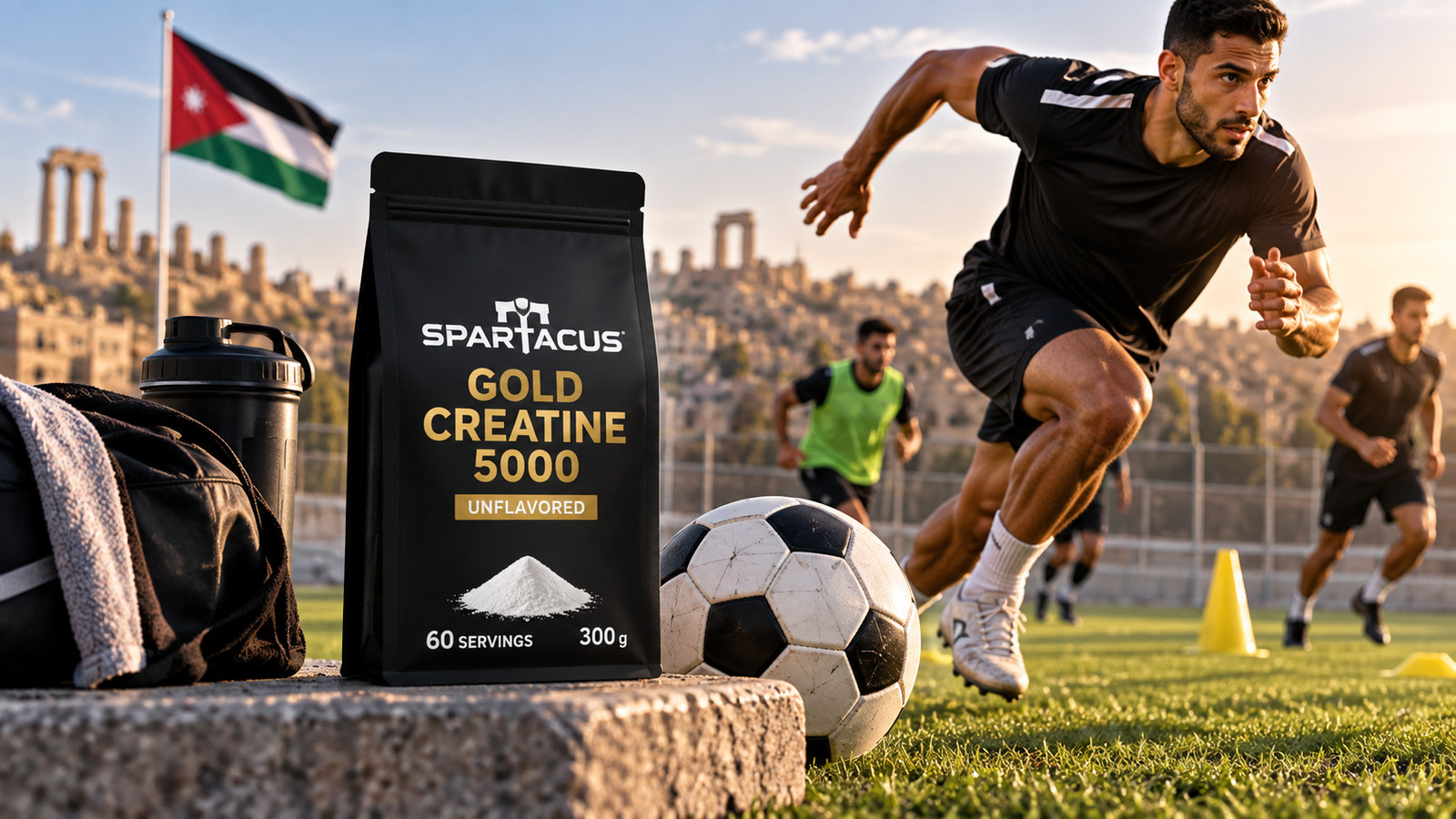
If you are considering creatine for football players in Jordan, the first thing to understand is that football is not purely an endurance sport.
A football match combines:
- Running
- Walking
- Repeated sprints
- Accelerations
- Decelerations
- Changes of direction
- Jumping
- Tackling
- Short high-intensity efforts
That makes creatine potentially relevant because its strongest evidence is related to repeated high-intensity exercise and rapid energy production.
Creatine should not be viewed as something that automatically makes a player faster or better at football.
Its value is more specific.
It may help support the high-intensity parts of the game and training.
A systematic review and meta-analysis in soccer players found that creatine supplementation did not consistently improve aerobic performance, but it did show benefits for some anaerobic-performance outcomes.
How Does Creatine Work for Football Players?
Creatine helps increase creatine and phosphocreatine stores inside muscle.
Phosphocreatine helps regenerate ATP rapidly.
ATP is the immediate energy source used during demanding muscular efforts.
For a football player, this can be relevant during:
- Sprinting
- Rapid acceleration
- Repeated pressing
- Powerful tackles
- Jumping
- Short explosive runs
- High-intensity training drills
Creatine is therefore more closely connected to repeated explosive efforts than to steady jogging.
Does Creatine Make Football Players Faster?
Not automatically.
The evidence for a single sprint is mixed.
However, football repeatedly requires high-intensity efforts throughout training and matches.
A meta-analysis of short-term creatine supplementation found an improvement in mean power output during repeated sprint testing, although effects on peak power and fatigue were less clear.
For football players, that distinction matters.
Creatine may be more relevant to your ability to repeat intense efforts than to magically lowering one isolated sprint time.
Creatine for Repeated Sprints
Repeated sprint ability is important in football.
Players may need to:
- Sprint forward
- Recover position
- Press an opponent
- Accelerate again
- Make another attacking run
all within a relatively short period.
Research specifically involving soccer players has reported some benefits of creatine for anaerobic performance, including repeated-sprint-related measures, although results vary across studies.
This makes repeated high-intensity performance one of the more relevant reasons football players may consider creatine.
Creatine for Acceleration
Acceleration is different from maximum-speed running.
Football players often accelerate from:
- Standing positions
- Jogging
- Sideways movement
- Defensive positions
Creatine cannot replace acceleration training.
However, because acceleration is a high-intensity muscular effort, creatine may support the training environment used to develop this quality.
The bigger picture still includes:
sprint training + strength + technique + recovery + nutrition
Creatine for Strength in Football
Strength plays an important role in football.
Players use strength during:
- Tackling
- Shielding the ball
- Jumping
- Sprinting
- Changing direction
- Holding position
- Accelerating
Creatine is well established as a supplement used alongside resistance training.
Football players who include strength sessions may therefore find creatine useful as part of their overall training programme.
The Spartacus article Best Creatine for Strength in Jordan can fit naturally here.
Creatine for Power
Power is the ability to produce force quickly.
Football requires power during actions such as:
- Jumping for headers
- Sprint starts
- Accelerations
- Rapid direction changes
- Explosive tackles
Creatine is particularly relevant to short-duration, high-intensity energy production.
That does not guarantee greater power in every athlete, but it is one reason creatine is commonly used in power-focused training.
Creatine and Change of Direction
Football is not played in straight lines.
Players repeatedly:
- Cut
- Turn
- Stop
- Accelerate
- Change direction
Creatine does not directly teach better movement technique.
But it may support the high-intensity training used to develop speed and power.
Strength, coordination and sport-specific practice remain essential.
Does Creatine Improve Football Endurance?
Creatine should not be treated as a traditional endurance supplement.
The soccer meta-analysis found no clear overall benefit for aerobic-performance tests.
Football endurance still depends heavily on:
- Aerobic fitness
- Conditioning
- Carbohydrate availability
- Hydration
- Pacing
- Training history
Creatine is more relevant to repeated high-intensity efforts within the match.
Creatine for Football Training
Creatine may fit especially well into training programmes that include:
- Repeated sprint training
- Strength training
- Speed work
- Plyometrics
- High-intensity intervals
- Small-sided games
- Gym sessions
It should be viewed as a supplement that supports the training process.
It does not replace the training itself.
Creatine Before a Football Match
Creatine does not work like caffeine.
Taking one serving immediately before a match does not suddenly increase muscle creatine stores.
Its effects depend more on consistent use over time.
So the better approach is generally:
regular daily use rather than match-day-only use
Creatine After Football Training
You can take creatine after training.
This can be convenient if you already have:
- A post-training meal
- A whey protein shake
- Water
- Another recovery drink
However, post-training timing is not mandatory.
Consistency is more important.
Can Football Players Take Creatine With Whey Protein?
Yes.
Creatine and whey protein have different roles.
Creatine
Helps support:
- Muscle creatine stores
- Rapid ATP regeneration
- High-intensity performance
- Repeated efforts
Whey Protein
Helps support:
- Daily protein intake
- Muscle repair
- Recovery
- Muscle maintenance
A simple option after training could be:
whey protein + creatine
The existing Spartacus article Creatine and Whey Protein Together can be linked naturally here.
Creatine for Recovery After Football
Football creates several types of physical stress:
- Running volume
- Sprinting
- Contact
- Direction changes
- Strength demands
Creatine may form part of a recovery-focused nutrition strategy.
But it does not replace:
sleep + protein + carbohydrates + hydration + calories + rest
For a deeper explanation, the existing Creatine for Recovery in Jordan article is relevant.
Does Creatine Reduce Muscle Soreness After Football?
Creatine should not be presented as a guaranteed treatment for soreness.
Muscle soreness depends on:
- Training intensity
- Match load
- New exercises
- Sprint volume
- Eccentric loading
- Recovery
- Sleep
Creatine may support the broader training system, but it does not eliminate soreness.
Creatine and Carbohydrates for Football Players
Football players need carbohydrates.
Carbohydrates are important for:
- Glycogen
- Running volume
- High-intensity efforts
- Match energy
- Recovery
Creatine and carbohydrates should not be treated as competitors.
They support different parts of performance.
Creatine
Supports rapid energy regeneration during intense efforts.
Carbohydrates
Provide a major fuel source for repeated and prolonged activity.
Football players should not reduce carbohydrate intake simply because they use creatine.
Creatine and Hydration in Jordan
Hydration is especially important for football players training in Jordan.
Fluid needs depend on:
- Temperature
- Humidity
- Training duration
- Sweat rate
- Body size
- Match intensity
Creatine does not mean you need to force excessive water intake.
The practical goal is to maintain appropriate hydration before, during and after training.
Does Creatine Cause Dehydration?
Creatine should not automatically be assumed to cause dehydration.
The more useful approach is to focus on normal hydration practices based on your training and environment.
Football players training outdoors in hot conditions should pay particular attention to fluid and electrolyte replacement regardless of whether they use creatine.
Does Creatine Cause Weight Gain?
It can increase body weight.
This is often related to increased water stored inside muscle tissue.
That is different from gaining body fat.
For football players, the practical question is whether a small body-weight increase affects:
- Speed
- Agility
- Comfort
- Position-specific performance
Individual response matters.
Is Creatine Good for Defenders?
It can fit the demands of defenders.
Defenders often require:
- Strength
- Jumping
- Acceleration
- Short sprints
- Physical contact
- Repeated explosive efforts
Creatine may support the high-intensity training used to develop those qualities.
Is Creatine Good for Midfielders?
Midfielders usually cover substantial running distances.
They also perform:
- Repeated accelerations
- Pressing
- Tackling
- Direction changes
- High-intensity runs
For midfielders, creatine may be more relevant to these high-intensity actions than to the aerobic running itself.
Is Creatine Good for Wingers and Forwards?
Wingers and forwards often rely heavily on:
- Sprinting
- Acceleration
- Explosive movements
- Repeated attacking runs
- Power
These demands align more closely with creatine’s established role in high-intensity exercise.
However, speed training and technical ability remain far more important than any supplement.
Is Creatine Good for Goalkeepers?
Goalkeepers have different demands.
They rely on:
- Explosive dives
- Jumping
- Short accelerations
- Strength
- Power
Creatine may fit well into a goalkeeper’s strength and power programme.
How Much Creatine Should Football Players Take?
A commonly used maintenance amount is:
3–5 g of creatine monohydrate per day
Spartacus Gold Creatine 5000 provides:
5 g of creatine per serving
with 60 servings per pouch.
This fits within the commonly used daily range.
Do Football Players Need a Loading Phase?
No.
A loading phase is optional.
Loading can increase muscle creatine stores more quickly.
However, regular daily intake can also increase stores gradually over time.
For many players, a simple daily routine is easier.
When Should Football Players Take Creatine?
There is no single mandatory time.
You could take it:
- With breakfast
- After training
- With a meal
- With whey protein
- At another convenient time
The main goal is consistency.
Should Football Players Take Creatine on Rest Days?
Yes, if they are using creatine consistently.
Creatine is generally used daily rather than only before matches or hard training sessions.
Rest days are also part of the recovery process.
Creatine During the Football Season
Creatine can be used during the competitive season.
However, players should consider:
- Match schedule
- Training load
- Body-weight response
- Hydration
- Individual tolerance
- Team nutrition advice
Players should avoid experimenting with unfamiliar supplement routines immediately before important matches.
Creatine During Pre-Season
Pre-season often includes:
- Strength training
- Conditioning
- Repeated sprints
- High training volume
- Power work
This can make pre-season a practical period for consistent creatine use.
However, creatine should still sit within a complete nutrition and recovery strategy.
Creatine for Young Football Players
Young athletes require more caution.
Minors should not simply copy adult supplement routines.
Supplement use should be discussed with:
- Parents or guardians
- A qualified sports dietitian
- Medical professionals when appropriate
- Coaches or club staff
Training, food, sleep and hydration should remain the priorities.
Spartacus Gold Creatine 5000 for Football Players
For football players in Jordan looking for a straightforward creatine monohydrate option, Spartacus Gold Creatine 5000 currently provides:
- 5 g creatine per serving
- 60 servings
- 300 g pouch
- Unflavored formula
The product is positioned for strength, power, endurance and training performance.
For football players, its most relevant role is supporting the repeated high-intensity demands of training and matches.
Common Mistakes Football Players Make With Creatine
Taking It Only Before Matches
Creatine is not an instant pre-match stimulant.
Expecting It to Replace Fitness Training
Creatine cannot replace conditioning.
Ignoring Carbohydrates
Football players still need carbohydrate fuel.
Ignoring Hydration
Hydration remains essential.
Taking Too Much
More is not automatically better.
Expecting Instant Speed
Creatine does not automatically make you faster after one serving.
Ignoring Body-Weight Changes
Some players may notice an increase in body weight due to increased muscle water.
Frequently Asked Questions
Is creatine good for football players?
It may be useful for repeated high-intensity efforts, strength, power and anaerobic performance. Evidence for aerobic football performance is less consistent.
Does creatine make football players faster?
Not automatically. It may be more useful for repeated high-intensity efforts than for one isolated sprint.
Does creatine help repeated sprints?
Research suggests creatine may improve some aspects of repeated-sprint and anaerobic performance, although results vary.
Can football players take creatine every day?
Yes. Consistent daily use is commonly used to maintain increased muscle creatine stores.
How much creatine should a football player take?
A commonly used daily amount is approximately 3–5 g of creatine monohydrate.
Should football players take creatine before a match?
They can, but exact timing is less important than consistent daily use.
Can football players take creatine with whey protein?
Yes. They serve different roles and can be used together.
Does creatine cause weight gain?
It can cause some increase in body weight, often related to increased water stored inside muscle tissue.
Is creatine good for football endurance?
Creatine is more relevant to repeated high-intensity actions than to steady aerobic endurance.
Final Thoughts: Creatine for Football Players in Jordan
Creatine can make sense for football players because football involves much more than steady running.
Its most relevant potential benefits relate to:
repeated sprints + acceleration + strength + power + high-intensity efforts
Research in soccer players suggests creatine may improve some anaerobic-performance measures, while benefits for aerobic performance are less consistent.
For football players in Jordan, Spartacus Gold Creatine 5000 provides 5 g of creatine per serving and can fit into a consistent training and nutrition routine.
The priorities still remain:
football training + conditioning + carbohydrates + protein + hydration + sleep + recovery + consistency.