


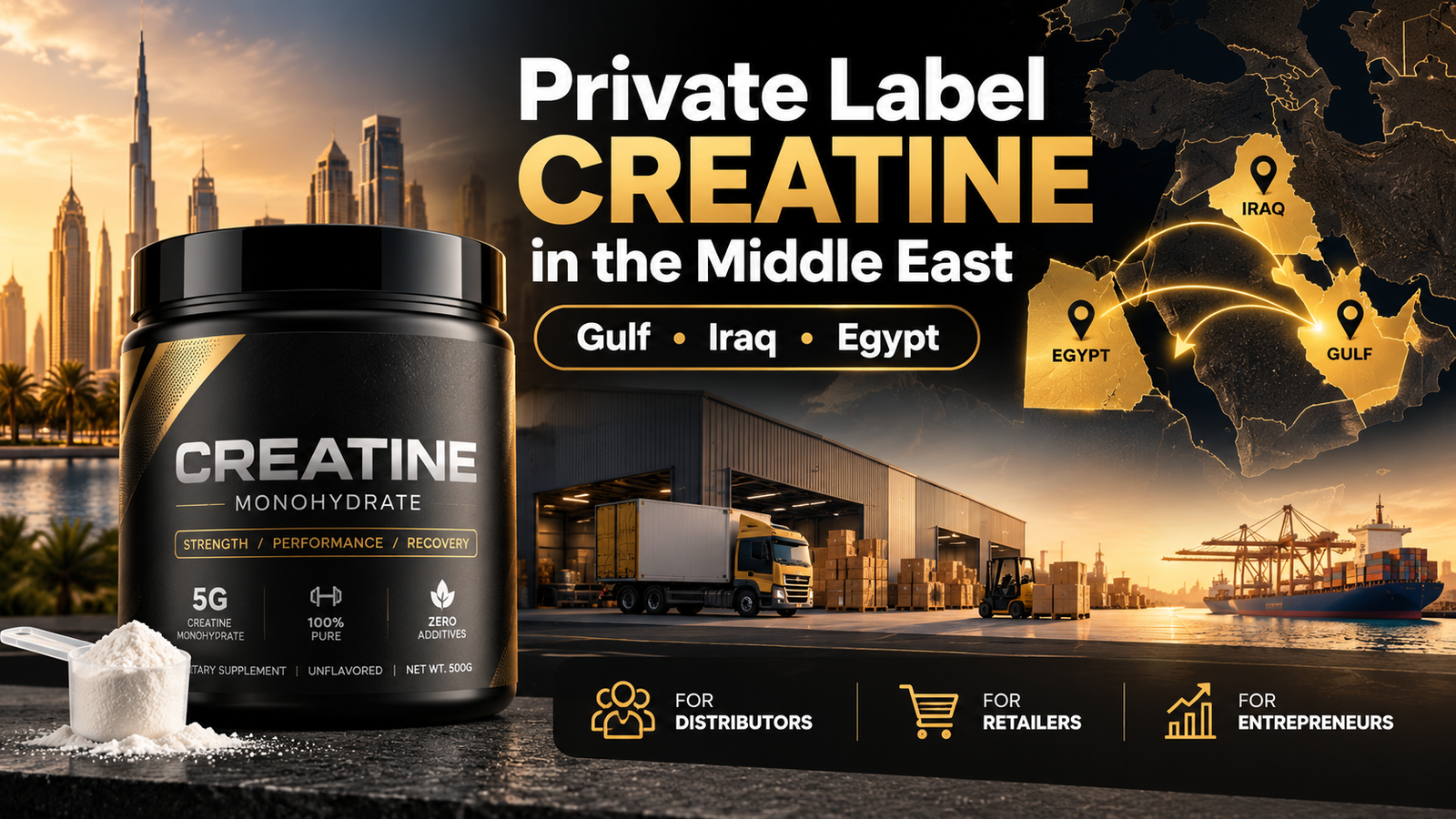
If you are searching for private label creatine Middle East opportunities, you may be looking for a way to launch your own creatine brand or expand your supplement business.
If you are searching for private label creatine in the Middle East, you are probably looking for more than a retail supplement.
You may want to:
- launch your own creatine brand
- add creatine to an existing supplement portfolio
- create a branded creatine product for a gym or retail chain
- distribute creatine across Saudi Arabia, UAE, Kuwait, Qatar, Oman or Bahrain
- enter the Iraqi or Egyptian sports nutrition market
- build a supplement brand without operating your own production facility
Private-label manufacturing can give distributors, retailers and entrepreneurs a route to market without building an entire supplement factory from the ground up.
What Is Private Label Creatine?
Private label creatine is a creatine product manufactured for another business to sell under its own brand.
The brand owner may control commercial elements such as:
- brand name
- packaging design
- product positioning
- target country
- pack size
- serving format
- labeling
- distribution strategy
The exact level of customization depends on the manufacturing agreement.
For a prospective buyer, the most important issue is not simply whether a product can carry a different logo.
It is whether the product, pack size, pricing and supply model fit the intended market.
Why Creatine Is a Strong Private Label Product
Creatine is one of the most recognized categories in sports nutrition.
Prospective buyers already search for questions such as:
- best creatine
- creatine monohydrate
- creatine price
- where to buy creatine
- creatine for beginners
- creatine for muscle gain
- creatine for strength
- creatine dosage
- creatine before or after workout
That existing consumer awareness can make creatine an attractive category for a distributor or new supplement brand.
Unlike a completely unfamiliar product category, buyers generally already understand what creatine is used for.
The commercial challenge is therefore positioning, pricing, trust, availability and distribution.
Why Creatine Monohydrate?
Creatine monohydrate is the most established form of creatine used in sports nutrition.
Spartacus currently sells Creatine 5000, which provides:
- 5 g creatine per serving
- 60 servings
- 300 g total
- creatine monohydrate
- unflavored format
The current retail product is listed at 15 JOD in Jordan. Spartacus Protein
For a B2B buyer, however, the important discussion is not the Jordan retail price.
It is the commercial specification required for the target market.
Who Can Use Private Label Creatine?
Supplement Distributors
An established distributor may want to create its own creatine line rather than relying entirely on imported third-party brands.
This can provide greater control over:
- branding
- positioning
- pricing
- availability
- retailer relationships
Supplement Stores
A retailer with an established customer base may decide to sell its own branded creatine product.
That can differentiate the store from competitors carrying exactly the same brands.
Gym Chains
Gyms may introduce creatine under their own brand as part of a broader sports nutrition range.
Online Supplement Businesses
E-commerce operators can use private labeling to build a proprietary product instead of competing only on the price of other manufacturers’ products.
Entrepreneurs
A new sports nutrition business may begin with a focused product line rather than launching many supplements at once.
Creatine can be a relatively straightforward category to understand commercially because buyers are already familiar with the product.
Private Label Creatine for Saudi Arabia
Saudi Arabia is one of the most important sports nutrition markets in the region.
A creatine brand targeting Saudi Arabia should consider:
- Arabic and English packaging
- distributor relationships
- local product registration
- retail pricing
- gym and trainer partnerships
- e-commerce
- replenishment and inventory
- market-specific labeling requirements
A successful launch requires more than importing inventory.
The product needs a reliable route from manufacturer to distributor to retailer or consumer.
Private Label Creatine for the UAE
The UAE has a highly competitive supplement market with significant exposure to international brands.
A new creatine brand entering the UAE may need a clear commercial position such as:
- competitive cost per serving
- premium positioning
- strong packaging
- high product availability
- gym partnerships
- retail distribution
- online marketplace presence
Because of its logistics and commercial infrastructure, the UAE can also be considered as part of a wider regional distribution strategy.
Private Label Creatine for Kuwait, Qatar, Bahrain and Oman
Smaller Gulf markets can still be commercially attractive, particularly for distributors with existing supplement-store or gym relationships.
For these markets, businesses should evaluate:
- market size
- order volume
- local distributor reach
- customer purchasing power
- import requirements
- shipping economics
The same package and pricing strategy may not work equally well in every country.
Private Label Creatine for Iraq
Iraq can present a strong distributor-led opportunity.
A business targeting Iraq should think carefully about:
- importer relationships
- wholesale networks
- supplement retailers
- gym distribution
- inventory continuity
- regional logistics
- price sensitivity
In a market where local distribution relationships are important, choosing the right commercial partner can matter as much as the product itself.
Private Label Creatine for Egypt
Egypt is a large but highly price-sensitive sports nutrition market.
A creatine brand entering Egypt should evaluate:
- target retail price
- pack size
- distributor margin
- local purchasing power
- gym and retailer channels
- e-commerce potential
- repeat purchase frequency
The most expensive-looking product is not automatically the best commercial product.
The offer must fit the economics of the target customer.
What Should a Distributor Ask a Creatine Manufacturer?
Before requesting a quotation, a distributor should prepare a clear list of commercial questions.
These can include:
- What type of creatine is used?
- Is it creatine monohydrate?
- How many grams are provided per serving?
- What pack sizes are available?
- Is an unflavored option available?
- What is the minimum order quantity?
- Can the packaging be customized?
- Can Arabic and English labeling be supported?
- What is the production lead time?
- What documentation can be supplied?
- Which countries can be supplied?
- What are the shipping terms?
- Can distributor exclusivity be discussed?
- What commercial volumes are expected?
Not every manufacturer will offer the same options, so these points should be confirmed directly rather than assumed.
White Label vs Private Label Creatine
The terms are often used interchangeably, but there can be a practical difference.
White Label Creatine
A white-label product is usually an existing formulation that another company can brand under its own name.
This can make the route to market simpler.
Private Label Creatine
Private label may involve more customization around:
- packaging
- serving format
- brand identity
- labeling
- positioning
- market requirements
The exact distinction depends on the manufacturer.
For buyers, the practical question is:
What can actually be customized?
Can You Launch Creatine Under Your Own Brand?
Yes, that is the purpose of private-label manufacturing.
The brand owner then develops the consumer-facing identity and sales strategy.
Distribution may include:
- supplement retailers
- gyms
- personal trainers
- online stores
- marketplaces
- wholesalers
- pharmacies where permitted
- regional distributors
How Much Does Private Label Creatine Cost?
There is no universal price.
The total commercial cost depends on factors such as:
- quantity
- pack size
- packaging
- label printing
- destination country
- shipping
- documentation
- branding
- regulatory requirements
- order frequency
A serious B2B quotation should therefore be based on the intended market and order volume.
What Pack Size Should You Choose?
The best pack size depends on the target customer.
A larger pack can reduce reorder frequency but may increase the upfront retail price.
A smaller pack can be easier for first-time buyers to try.
For example, the current Spartacus Creatine 5000 consumer product uses a 300 g pouch with 60 servings at 5 g per serving. Spartacus Protein
That does not mean every private-label product must use the same size.
The B2B decision should be based on the target market.
Should You Sell Creatine in a Pouch or Tub?
Both formats can work.
Pouch
Potential advantages can include:
- lighter packaging
- reduced shipping volume
- easier storage
- lower packaging weight
Tub
Potential advantages can include:
- traditional supplement appearance
- rigid packaging
- stronger shelf presence
The correct format depends on brand positioning, logistics and customer preference.
Should Private Label Creatine Be Flavored or Unflavored?
Unflavored creatine is common because it can be mixed into:
- water
- juice
- whey protein
- pre-workout drinks
- other suitable beverages
Spartacus Creatine 5000 is currently sold as an unflavored creatine monohydrate product. Spartacus Protein
A private-label buyer should still confirm available flavor and formulation options directly.
How Important Is Cost Per Serving?
Very important.
B2B buyers should not compare only the package price.
They should compare:
total price ÷ number of servings
For creatine, buyers should also compare:
- grams per serving
- total grams
- number of servings
- cost per serving
- cost per gram
- packaging
- shipping
- distributor margin
This gives a much clearer commercial picture.
Can a Distributor Get Exclusive Rights?
Potential exclusivity depends on the commercial agreement.
A manufacturer may consider factors such as:
- country
- order volume
- distributor network
- expected sales
- marketing commitment
- payment terms
- market coverage
Exclusivity should therefore be negotiated rather than assumed.
Is Private Label Better Than Distributing an Existing Creatine Brand?
Each model has advantages.
Distributing an Existing Brand
Can provide:
- existing brand awareness
- existing packaging
- established product identity
- easier market introduction
Building a Private Label Brand
Can provide:
- ownership of the brand
- stronger differentiation
- more control over positioning
- more control over pricing strategy
- potential long-term brand equity
The better model depends on the distributor’s objectives.
Why Spartacus Is Relevant to B2B Buyers
Spartacus currently markets sports nutrition products including Creatine 5000 and Pure Whey 100. Its current Creatine 5000 product is positioned as creatine monohydrate, provides 5 g per serving and 60 servings, and Spartacus states its supplements are crafted in the United Kingdom. Spartacus Protein
For prospective distributors or private-label partners, however, retail product information is only a starting point.
The B2B discussion should focus on:
- production capability
- volume
- product specification
- packaging
- target market
- logistics
- documentation
- distribution
- commercial terms
Those details should be confirmed directly during the B2B inquiry process.
Frequently Asked Questions
What is private label creatine?
Private label creatine is creatine manufactured for a company to sell under its own brand.
Can I launch my own creatine brand in the Middle East?
Potentially, yes. The launch depends on the manufacturing agreement, local regulations, packaging, product registration and distribution requirements in the target market.
Can I private label creatine for Saudi Arabia?
A creatine product can potentially be developed for the Saudi market, subject to the applicable commercial and regulatory requirements.
Can I distribute creatine in Iraq?
Businesses can explore distributor arrangements for Iraq depending on local requirements, supply terms and the commercial agreement.
Can I launch a creatine brand in Egypt?
Yes, Egypt can be approached through private label, distribution or other B2B models depending on the commercial setup and local requirements.
Can I customize the packaging?
Packaging customization depends on the manufacturing agreement and available production options.
What should I prepare before requesting a quote?
Prepare:
- target country
- expected order quantity
- desired pack size
- preferred packaging
- target retail customer
- intended sales channels
- branding requirements
- expected distribution model
Final Thoughts
Private-label creatine can provide distributors, retailers, gym operators and entrepreneurs with a path to building their own sports nutrition brand.
The opportunity extends across:
Saudi Arabia + UAE + Kuwait + Qatar + Oman + Bahrain + Iraq + Egypt
But the process should begin with the commercial model, not just the logo.
Start with:
target market + creatine specification + pack size + volume + pricing + distribution strategy + commercial terms