


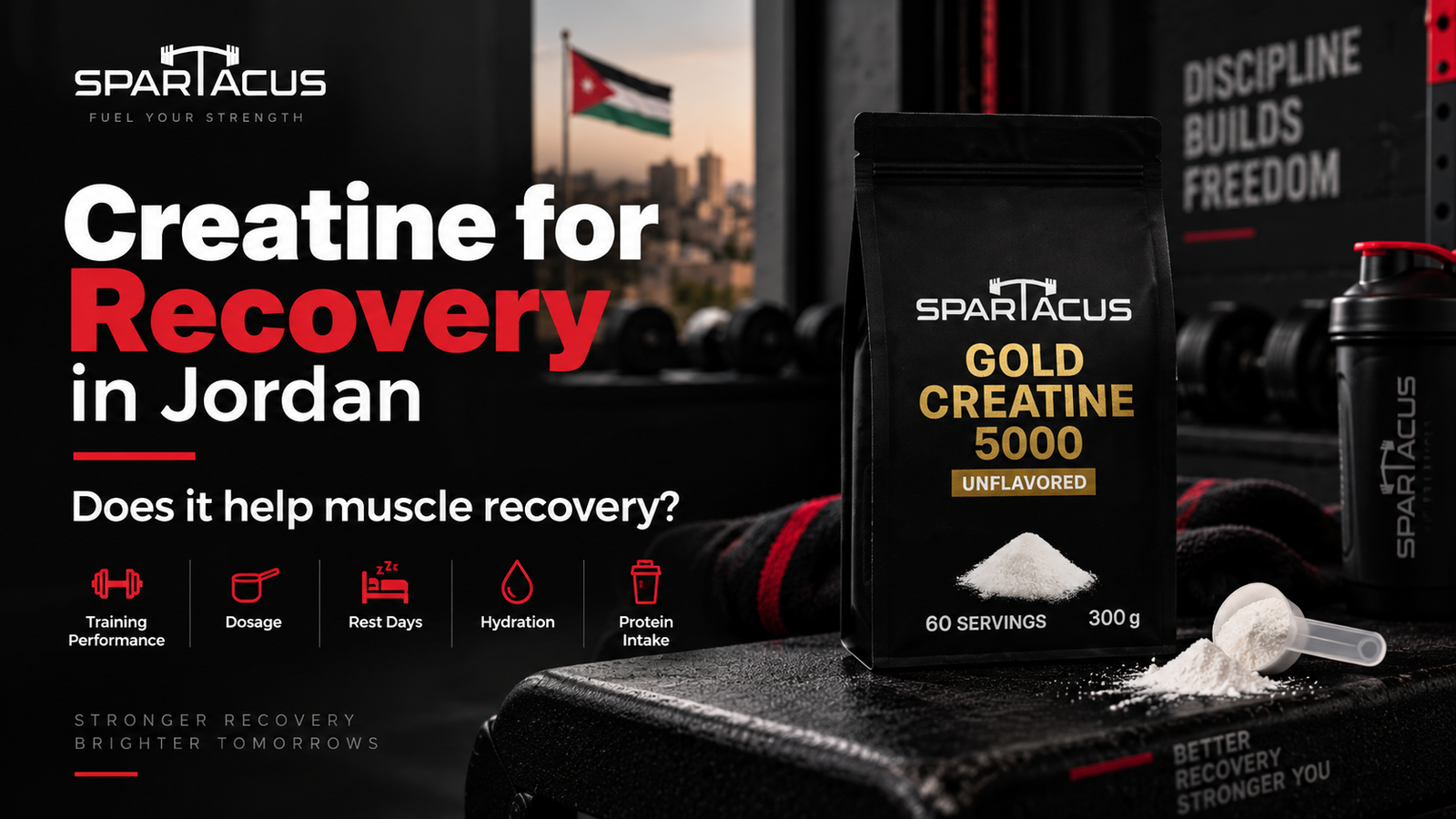
If you are considering creatine for recovery in Jordan, it is important to understand what creatine can — and cannot — do.
Creatine is best known for supporting repeated high-intensity exercise and helping increase muscle creatine stores.
But recovery is more complicated than simply taking one supplement.
Your ability to recover from training depends heavily on:
- Sleep
- Protein intake
- Total calories
- Hydration
- Training volume
- Rest between sessions
- Overall nutrition
Creatine can fit into that recovery strategy, but it should support these fundamentals rather than replace them.
Does Creatine Help Muscle Recovery?
Creatine may support recovery in several indirect ways.
Its main role is helping increase the availability of creatine and phosphocreatine in muscle.
These compounds are involved in rapidly producing energy during demanding exercise.
By supporting repeated high-intensity training performance, creatine may help you maintain training quality across workouts.
However, creatine should not be treated as a direct replacement for:
protein + food + sleep + hydration + rest
Those factors remain essential for muscle recovery.
How Does Creatine Work?
Your muscles use adenosine triphosphate, or ATP, for energy.
During short, intense efforts such as:
- Heavy lifting
- Sprinting
- Explosive movements
- High-intensity sets
ATP is used very quickly.
Stored phosphocreatine helps regenerate ATP.
Taking creatine consistently can increase muscle creatine stores, which can support repeated high-intensity exercise.
This is why creatine is commonly associated with strength, power, training performance and muscle-building programmes.
Is Creatine a Recovery Supplement?
It can be part of a recovery programme, but describing creatine only as a “recovery supplement” is too simplistic.
Creatine is primarily used to support:
- Muscle creatine stores
- High-intensity exercise
- Strength training
- Repeated training efforts
- Power output
- Training volume
Recovery benefits are better understood within this larger training context.
If better training performance allows you to train more consistently over time, creatine may indirectly support your overall training and recovery strategy.
Creatine vs Whey Protein for Recovery
Creatine and whey protein have different roles.
Creatine
Creatine mainly supports:
- Muscle energy availability
- High-intensity training
- Strength
- Repeated exercise performance
Whey Protein
Whey protein mainly helps you:
- Increase daily protein intake
- Obtain essential amino acids
- Support muscle protein synthesis
- Meet protein targets more conveniently
For recovery after training, adequate protein intake remains extremely important.
Creatine can complement protein intake rather than replace it.
Whey Protein for Recovery in Jordan
Can You Take Creatine and Whey Protein Together for Recovery?
Yes.
Creatine and whey protein can be used within the same nutrition routine because they serve different purposes.
A simple post-workout option could be:
Whey protein + creatine
There is no requirement to separate them.
The more important questions are whether you are:
- Meeting your daily protein requirement
- Taking creatine consistently
- Eating enough food
- Sleeping adequately
- Managing training volume
Can You Take Creatine and Whey Protein Together?
How Much Creatine Should You Take for Recovery?
A commonly used daily creatine monohydrate amount is approximately:
3–5 g per day
Spartacus Gold Creatine 5000 currently provides 5 g of creatine per serving and 60 servings per pouch. Spartacus Protein
For most people, consistency matters more than taking creatine only after particularly difficult workouts.
Should You Take Creatine After Workout for Recovery?
You can.
Taking creatine after training can be convenient, especially if you already drink a protein shake or eat a post-workout meal.
But you do not have to take creatine immediately after exercise for it to work.
Creatine works primarily by gradually increasing and maintaining muscle creatine stores.
For most people:
daily consistency > perfect timing
Your existing creatine timing guide also explains that taking creatine consistently is generally more important than choosing an exact pre- or post-workout minute. Spartacus Protein
Creatine Before or After Workout?
Should You Take Creatine on Rest Days?
Yes.
Rest days are still part of your training programme.
Creatine is generally taken consistently, including on days when you do not train.
You can take your usual serving:
- With breakfast
- With another meal
- In a protein shake
- With water
- At another convenient time
There is no need to wait until your next workout.
Does Creatine Reduce Muscle Soreness?
Creatine should not be marketed as a guaranteed solution for muscle soreness.
Muscle soreness after training can be influenced by:
- New exercises
- Training volume
- Exercise intensity
- Eccentric movements
- Training experience
- Recovery
- Sleep
Creatine may be part of an overall recovery strategy, but it does not mean you will never feel sore after training.
Does Creatine Help You Recover Between Sets?
Creatine is particularly relevant to repeated short-duration, high-intensity activity.
Because phosphocreatine contributes to rapid ATP regeneration, increasing muscle creatine stores may help support repeated training efforts.
This is one reason creatine is commonly used during:
- Strength training
- Bodybuilding
- Sprint training
- Power training
- High-intensity exercise
That is different from claiming creatine instantly “repairs” your muscles between sets.
Creatine for Recovery After Strength Training
Strength training places significant demands on the muscles and nervous system.
Recovery from strength training still depends on:
protein + calories + sleep + hydration + rest + sensible programming
Creatine can support the performance side of that system.
If your main goal is strength, you can also read:
Best Creatine for Strength in Jordan
Creatine for Recovery After Bodybuilding Workouts
Bodybuilding programmes often involve:
- Multiple sets
- Moderate-to-high training volume
- Repeated resistance exercise
- Progressive overload
Creatine can fit naturally into this type of programme.
However, muscle recovery and growth still require adequate daily protein and sufficient calories.
Creatine cannot compensate for consistently poor nutrition.
Creatine for Recovery During Cutting
You can continue using creatine while cutting.
During a calorie deficit, maintaining training quality and strength can become more difficult.
Creatine may help support high-intensity exercise performance while calories are reduced.
However, recovery during cutting becomes especially dependent on:
- Adequate protein
- A sensible calorie deficit
- Sleep
- Stress management
- Training volume
Creatine for Cutting
Creatine for Recovery During Bulking
Creatine can also fit well into a bulking phase.
During bulking, you may be training with:
- Higher volume
- Progressive overload
- More demanding resistance sessions
Creatine can support your ability to perform repeated high-intensity work.
But muscle growth still requires adequate calories and protein.
Does Creatine Help Recovery if You Do Not Eat Enough Protein?
Creatine and protein do different jobs.
Creatine cannot replace dietary protein.
If your protein intake is too low, simply taking creatine will not solve that problem.
Protein provides amino acids needed for muscle maintenance and growth.
If you struggle to meet your protein needs through food, whey protein may be a convenient option.
Creatine and Hydration
Creatine increases water stored within muscle tissue.
That does not mean you need to drink extreme amounts of water.
Instead, maintain normal, appropriate hydration based on factors such as:
- Climate
- Exercise
- Sweat rate
- Body size
- Daily activity
This is particularly relevant for people training in Jordan’s warmer conditions.
Drink according to your needs rather than forcing excessive amounts of water simply because you use creatine.
Does Creatine Cause Water Retention?
Creatine can increase water stored inside muscle cells.
This may result in some increase in body weight.
That is not the same as gaining body fat.
For athletes and gym-goers, increased intracellular water is a known part of creatine supplementation.
Internal links:
Does Creatine Cause Weight Gain?
Does Creatine Cause Bloating?
How Long Does Creatine Take to Support Training?
Creatine is not normally an instant-effect supplement.
It works by gradually increasing muscle creatine stores.
How quickly this happens depends partly on whether you use a loading phase or simply take a regular daily amount.
The key point is consistency.
Do not judge creatine based on how you feel after one serving.
How Long Does Creatine Take to Work?
Do You Need a Creatine Loading Phase for Recovery?
No.
A loading phase can increase muscle creatine stores faster, but it is not required.
You can simply take a regular daily amount consistently.
For many people, this is easier and may also reduce the chance of digestive discomfort from taking larger amounts at once.
Can Creatine Help You Train More Frequently?
Creatine may support repeated high-intensity exercise performance.
But this does not mean you should automatically increase your training frequency.
Your training schedule still needs to consider:
- Experience
- Exercise selection
- Training volume
- Intensity
- Sleep
- Nutrition
- Individual recovery ability
Creatine supports training.
It does not make recovery unlimited.
Spartacus Gold Creatine 5000 for Recovery
For people in Jordan looking for a straightforward creatine monohydrate option, Spartacus Gold Creatine 5000 currently provides:
- 5 g creatine per serving
- 60 servings
- 300 g pouch
- Unflavored creatine
The current Spartacus product listing positions it for strength, muscle performance, power and recovery, and currently lists it at 15 JOD. Spartacus Protein
Common Mistakes When Using Creatine for Recovery
Expecting Creatine to Replace Sleep
No supplement can compensate for consistently poor sleep.
Sleep remains one of the foundations of physical recovery.
Ignoring Protein Intake
Creatine does not provide dietary protein.
Make sure your overall protein intake is appropriate for your training goals.
Taking Creatine Only When You Feel Sore
Creatine is normally used consistently rather than only when muscle soreness appears.
Taking Excessive Amounts
More is not automatically better.
A standard daily amount is sufficient for most users.
Expecting Instant Results
Creatine works by increasing muscle creatine stores over time.
Ignoring Training Volume
If you consistently train beyond your ability to recover, creatine alone will not solve the problem.
Frequently Asked Questions
Is creatine good for muscle recovery?
Creatine can be part of an overall recovery strategy, particularly because it supports repeated high-intensity exercise and muscle creatine availability. Recovery still depends heavily on nutrition, sleep and training management.
Should I take creatine after workout?
You can, but exact timing is generally less important than taking creatine consistently.
Should I take creatine every day?
Creatine is commonly taken daily, including on rest days, to help maintain increased muscle creatine stores.
Does creatine reduce muscle soreness?
Creatine should not be considered a guaranteed treatment for muscle soreness. Soreness depends on many factors including training volume, exercise type and recovery.
Is 5 g of creatine enough?
Five grams falls within the commonly used daily creatine monohydrate range for many adults.
Can I take creatine and whey protein together?
Yes. Creatine and whey protein serve different purposes and can be used together.
Does creatine replace protein?
No. Creatine and protein have completely different nutritional roles.
Can I take creatine on rest days?
Yes. Daily consistency is commonly used even when you are not training.
Does creatine help recovery during cutting?
Creatine may support training performance during a calorie deficit, but adequate protein, calories, sleep and appropriate training volume remain important.
Final Thoughts: Creatine for Recovery in Jordan
Creatine can be useful within a recovery-focused training routine, but it should not be viewed as a shortcut.
The bigger recovery picture is:
sleep + protein + calories + hydration + sensible training + consistency
Creatine can support that system by increasing muscle creatine stores and supporting repeated high-intensity exercise.
For people in Jordan, Spartacus Gold Creatine 5000 provides 5 g of creatine per serving and can be incorporated into a consistent daily training and recovery routine.