


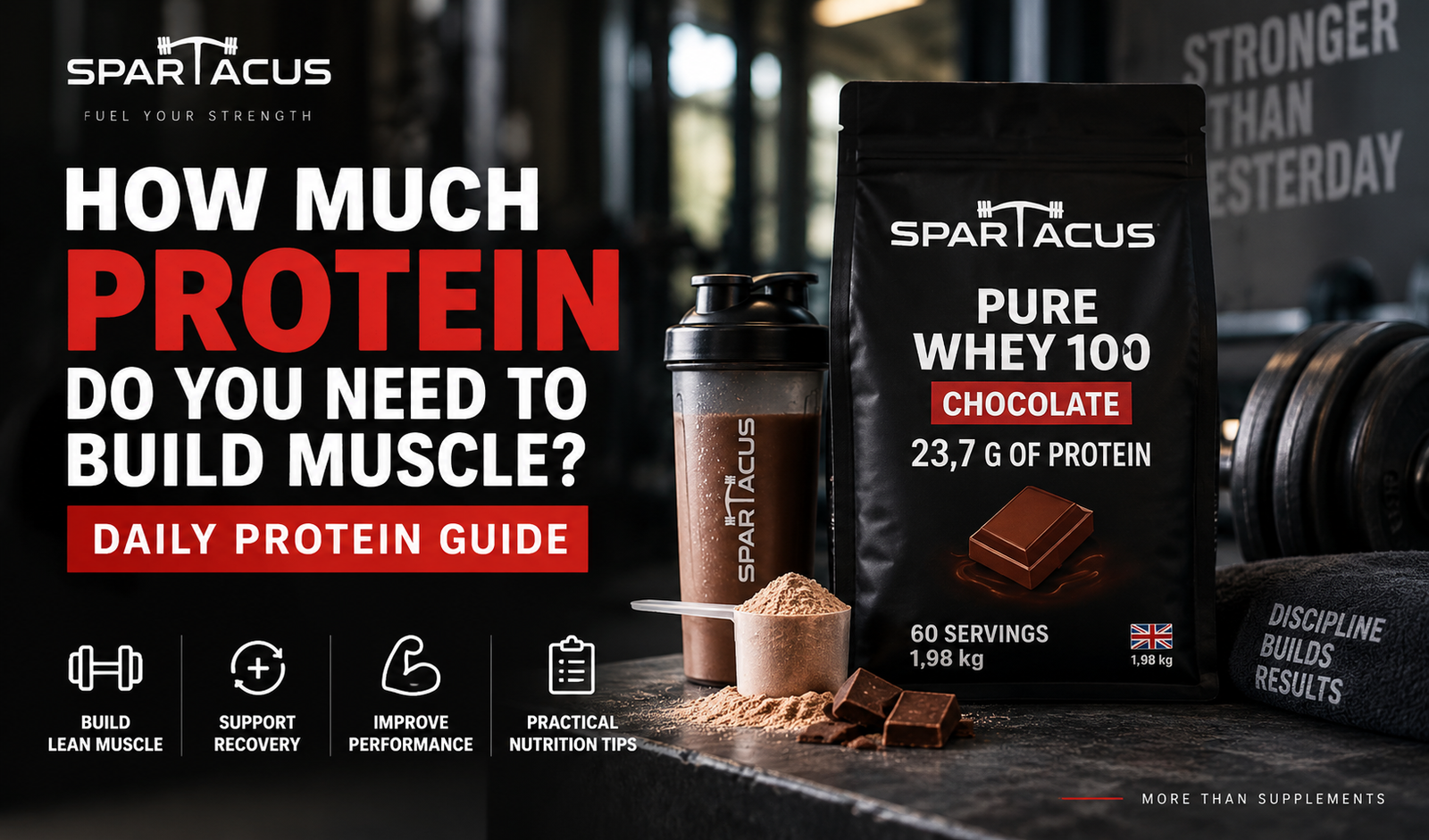
If you’re wondering how much protein to build muscle effectively, the answer depends on more than simply drinking protein shakes. Protein plays a central role in muscle growth, recovery, and maintaining lean body mass.
How much protein do you need to build muscle?
The answer depends on factors such as your body weight, training routine, total calorie intake, and overall diet. Eating more protein does not automatically mean more muscle, and relying only on protein shakes is not the goal either.
For most people who perform resistance training, the practical approach is to consume enough protein throughout the day while combining it with progressive training, adequate nutrition, sleep, and recovery.
In this guide, we’ll explain how much protein you may need for muscle growth, how to calculate your daily intake, how to distribute protein across meals, and where whey protein can fit into your nutrition plan.
Why Is Protein Important for Building Muscle?
Muscle tissue is constantly undergoing processes of breakdown and repair.
Resistance training provides a stimulus that encourages the body to adapt. Dietary protein supplies amino acids that the body can use for muscle protein synthesis and repair.
This is why adequate protein intake is an important part of a muscle-building nutrition plan.
However, protein works together with training. Simply increasing protein intake without an appropriate resistance-training program will not produce the same adaptations as combining sufficient protein with consistent exercise.
Your overall diet, energy intake, training quality, recovery, and sleep also contribute to your results.
How Much Protein Do You Need to Build Muscle?
According to the International Society of Sports Nutrition, an overall daily protein intake of approximately 1.4–2.0 grams per kilogram of body weight per day is sufficient for most exercising individuals who want to build or maintain muscle mass.
For many people performing resistance training, an intake around 1.6 grams per kilogram of body weight per day can provide a useful practical starting point within this range. Individual requirements can still vary.
Here are some examples:
| Body Weight | Protein at 1.6 g/kg | Protein at 2.0 g/kg |
|---|---|---|
| 60 kg | 96 g/day | 120 g/day |
| 70 kg | 112 g/day | 140 g/day |
| 80 kg | 128 g/day | 160 g/day |
| 90 kg | 144 g/day | 180 g/day |
| 100 kg | 160 g/day | 200 g/day |
These numbers should be treated as practical reference points rather than exact requirements that every athlete must follow.
Your appropriate intake can depend on your goals, training volume, calorie intake, age, food preferences, and other individual factors.
How Do You Calculate Your Daily Protein Needs?
A simple way to estimate your daily protein target is:
Body weight in kilograms × daily protein target = grams of protein per day
For example, someone who weighs 80 kg and chooses a target of 1.6 g/kg would calculate:
80 × 1.6 = 128 grams of protein per day
Someone at the same body weight using 2.0 g/kg would calculate:
80 × 2.0 = 160 grams of protein per day
You do not need to hit the exact number perfectly every day.
The goal is to establish a sustainable eating pattern that consistently provides enough high-quality protein alongside your overall nutritional needs.
Is More Protein Always Better for Muscle Growth?
Not necessarily.
Once your protein intake is sufficient to support your training and recovery needs, consuming increasingly large amounts does not guarantee additional muscle growth.
Muscle development still depends heavily on progressive resistance training, sufficient overall nutrition, recovery, and consistency.
Protein is one part of that system.
This is also why extremely high protein targets can make a diet unnecessarily difficult to maintain. A balanced approach leaves room for carbohydrates, dietary fats, fruits, vegetables, and other foods that contribute to performance and overall nutrition.
How Much Protein Should You Eat Per Meal?
Your total daily protein intake is an important priority, but distributing protein across several meals can also be a practical strategy.
Instead of consuming most of your protein in one meal, you can spread protein-containing foods throughout the day.
For example, your routine might include protein at:
- Breakfast
- Lunch
- A pre- or post-workout meal
- Dinner
- A snack or shake when needed
The International Society of Sports Nutrition notes a general recommendation of approximately 20–40 grams of high-quality protein per serving, although individual needs can depend on factors such as body size, age, training and total daily requirements.
The important point is not to become obsessed with an exact number at every meal.
Focus first on meeting your overall daily protein needs consistently.
Should You Eat Protein Before or After a Workout?
Both can be useful.
Protein consumed around your workout contributes to your overall daily protein intake and provides amino acids that can support muscle protein remodeling.
You do not need to panic about consuming a protein shake within a few minutes of completing your final set.
If you have eaten a protein-containing meal before training, amino acids from that meal may still be available during and after your workout.
Likewise, having a protein-rich meal or whey protein shake after training is a convenient way to continue meeting your daily requirements.
The broader goal is to consume sufficient protein throughout the day rather than relying on an extremely narrow post-workout window.
Do You Need Protein on Rest Days?
Yes, your protein requirements do not suddenly disappear on rest days.
Muscle recovery and adaptation continue after the workout itself, which is why maintaining a relatively consistent protein intake across both training and rest days is a practical approach.
You might adjust your overall calorie or carbohydrate intake according to your training schedule and goals, but there is generally no reason to dramatically reduce protein simply because you are taking a day away from the gym.
Think about protein as part of your daily nutrition routine, not only as something you consume immediately around workouts.
What Are Good Sources of Protein for Muscle Building?
Protein can come from a wide variety of foods.
Common sources include:
- Chicken, turkey, beef, and other meats
- Fish and seafood
- Eggs
- Milk, yogurt, and other dairy products
- Legumes and pulses
- Soy foods
- Nuts and seeds
- Other plant-based protein sources
- Protein supplements such as whey protein
A varied diet can help provide protein alongside other important nutrients.
Your protein intake does not need to come entirely from supplements.
Do You Need Whey Protein to Build Muscle?
No. Whey protein is not required to build muscle.
You can meet your protein requirements through food alone.
However, whey protein can be a convenient way to increase daily protein intake, particularly for people who find it difficult to reach their target through regular meals.
For example, Spartacus Pure Whey 100 provides 23.8 grams of protein per serving, according to its product information, making it a convenient option for adding protein to your daily nutrition routine.
Whey protein can also be prepared quickly and incorporated into different schedules. You might use a whey protein shake after training, between meals, or at another time when getting enough protein from food is inconvenient.
The important distinction is that whey protein is a supplement to your diet, not a replacement for a balanced diet.
Can You Take Whey Protein and Creatine Together?
Yes.
Whey protein and creatine serve different purposes and can be included in the same sports nutrition routine.
Whey protein provides dietary protein and essential amino acids, while creatine supplementation can help increase muscle creatine stores.
Many athletes therefore add creatine to a whey protein shake because it provides a simple way to include both supplements in an established routine.
For a detailed explanation, read our guide: Creatine and Whey Protein Together: Can You Take Them at the Same Time?
You can also read our guide on whether to take creatine before or after your workout if you want to understand how creatine timing fits into your training routine.
How Much Protein Is in a Whey Protein Shake?
The amount of protein in a whey shake depends on the specific product and serving size.
Always check the nutrition information and serving instructions on the product you are using rather than assuming every scoop provides the same amount.
You should also count protein from your shake as part of your total daily protein intake.
For example, if your daily target is 140 grams and your shake provides approximately 24 grams of protein, that protein contributes toward the 140-gram daily total.
The remainder can come from meals and other protein-containing foods throughout the day.
Can You Build Muscle Without Protein Supplements?
Absolutely.
Protein supplements are primarily a matter of convenience.
If your regular diet already provides enough high-quality protein to support your goals, you do not necessarily need protein powder.
Supplements become useful when they make it easier to meet your nutritional targets.
For someone with a busy schedule, for example, preparing a shake may be more practical than preparing another full meal.
The foundation should still be your overall diet.
Protein Intake When Trying to Lose Fat
Protein can also be particularly important when your goal is reducing body fat while maintaining muscle.
During a calorie deficit, resistance training and adequate protein intake can help support the preservation of lean mass.
Individual protein needs can vary during dieting depending on factors such as body composition, the size of the calorie deficit, and training demands.
This is another reason protein recommendations should be viewed as ranges rather than a single number that applies perfectly to everyone.
Common Protein Intake Mistakes
One common mistake is focusing entirely on supplements while ignoring total daily nutrition.
Another is consuming very little protein during most of the day and then trying to compensate with one very large meal.
Some people also assume that dramatically increasing protein will compensate for inconsistent training or insufficient recovery.
A better approach is simpler:
Train consistently, consume enough protein, maintain an appropriate overall diet, and give your body time to recover and adapt.
Frequently Asked Questions
How much protein do I need per day to build muscle?
For most exercising individuals who want to build or maintain muscle mass, the International Society of Sports Nutrition identifies an overall daily range of approximately 1.4–2.0 grams of protein per kilogram of body weight. Individual needs can vary depending on training, body weight, calorie intake and goals.
Is 100 grams of protein enough to build muscle?
It depends on your body weight and overall requirements. For a 60 kg person, 100 grams equals approximately 1.67 g/kg per day. For a 100 kg person, the same 100 grams equals only 1.0 g/kg per day. Protein targets are therefore more useful when considered relative to body weight.
Is 150 grams of protein enough to build muscle?
For many people, 150 grams may fall within an appropriate daily range, but the answer depends on body weight, training, total nutrition, and individual goals.
For example, 150 grams represents approximately 1.88 g/kg for someone weighing 80 kg.
Do I need protein immediately after my workout?
No. You do not need to consume protein within a few minutes of finishing your workout. A post-workout meal or shake can be convenient, but your overall daily protein intake and eating pattern are more important than trying to hit an extremely narrow timing window.
Should I drink a protein shake every day?
You can use a protein shake on days when it helps you meet your daily protein requirements. Whether you need one every day depends on how much protein you already obtain from food.
Can I take protein on rest days?
Yes. Recovery and muscle remodeling continue between training sessions, so maintaining adequate protein intake on rest days is a practical approach.
Can I take whey protein and creatine together?
Yes. Whey protein and creatine can be used together because they serve different purposes. Whey helps contribute toward your daily protein intake, while creatine helps increase muscle creatine stores.
Build Your Daily Protein Routine
When asking how much protein you need to build muscle, avoid searching for one perfect number that works for everyone.
Start with a reasonable protein target based on your body weight and training goals, distribute protein across your meals, train consistently, and adjust your nutrition according to your goals and progress.
Whole foods should form the foundation of your diet, while whey protein can provide a convenient option when you need help reaching your daily protein target.
Looking for a convenient way to support your daily protein intake? Explore Spartacus Pure Whey 100 and the wider Spartacus Protein sports nutrition range to find products that fit your training and nutrition goals.