


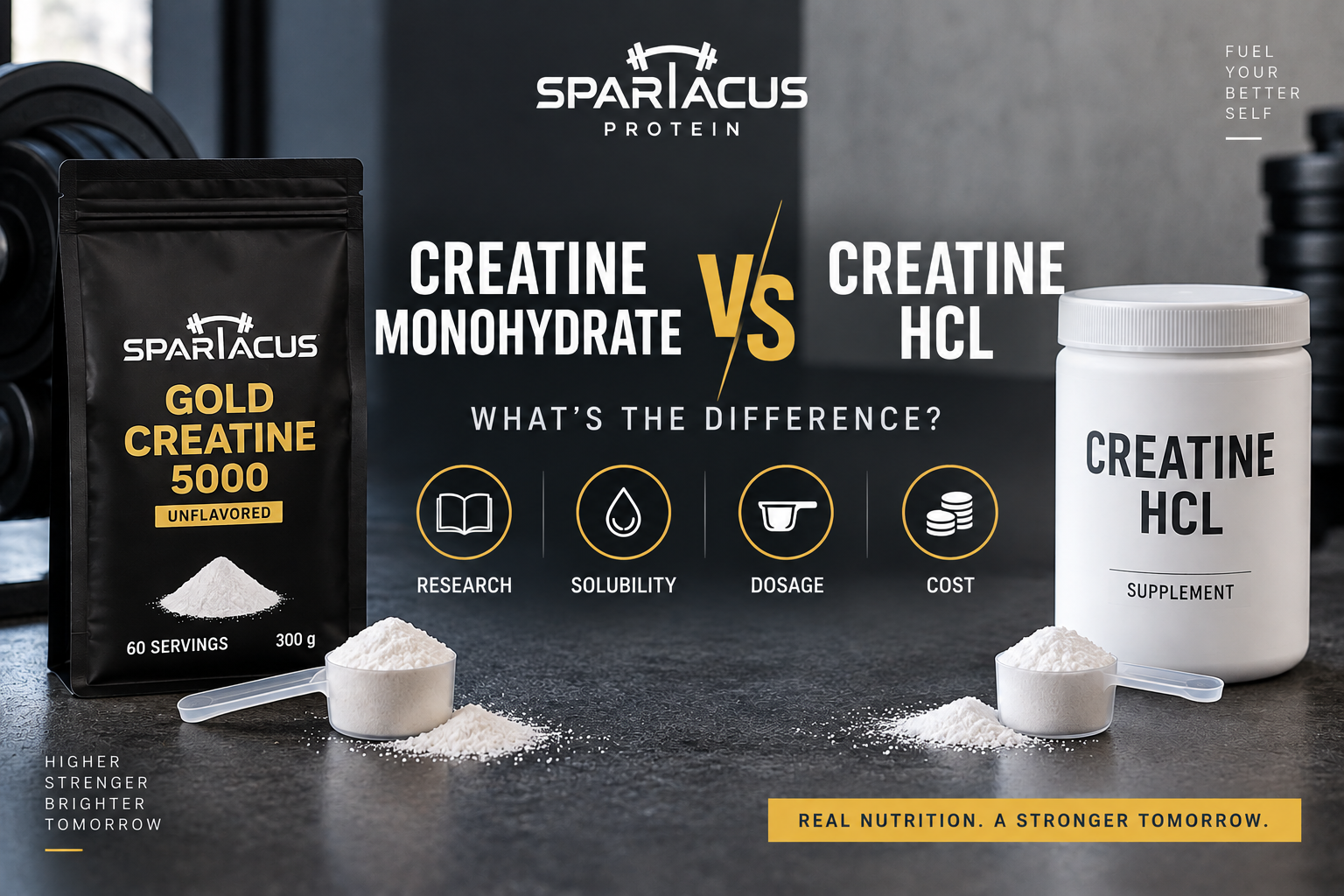
Creatine Monohydrate vs Creatine HCL: What’s the Difference?
If you are comparing creatine supplements, you may come across two common names:
Creatine monohydrate and creatine HCL.
Both provide creatine, but they are not exactly the same form.
The main differences involve:
- Chemical form
- Solubility
- Typical serving size
- Research evidence
- Cost
- Availability
For most people choosing a creatine supplement, understanding these differences is more useful than simply assuming the newer or more expensive version is automatically better.
What Is Creatine Monohydrate?
Creatine monohydrate is creatine combined with one molecule of water.
It is the form most commonly used in sports nutrition research.
In a recent review of 343 randomized controlled trials involving oral creatine, creatine monohydrate was the most commonly used formulation, appearing in more than 80% of the trials where the form was reported. PubMed
It is commonly used to support:
- Strength training
- Repeated high-intensity performance
- Training volume
- Muscle-building programs
- Athletic performance
Creatine monohydrate is also widely available and relatively straightforward to dose.
What Is Creatine HCL?
Creatine HCL stands for creatine hydrochloride.
In this form, creatine is chemically bound to hydrochloride.
One important difference is solubility.
Laboratory research has found creatine hydrochloride to be substantially more soluble in water than creatine monohydrate. PubMed
This higher solubility is one reason creatine HCL is sometimes marketed as requiring smaller doses.
However, greater solubility does not automatically mean better muscle-building or strength results.
Creatine Monohydrate vs Creatine HCL: Quick Comparison
| Feature | Creatine Monohydrate | Creatine HCL |
|---|---|---|
| Research history | Extensive | More limited |
| Water solubility | Lower | Higher |
| Common daily amount | Around 3–5 g | Often marketed at smaller doses |
| Availability | Very high | Less common |
| Cost | Usually lower | Often higher |
| Evidence for superior performance | Strong overall evidence | No clear superiority established |
Which One Has More Research?
Creatine monohydrate has considerably more research behind it.
It has been studied for decades across:
- Strength
- Power
- Muscle creatine storage
- Body composition
- High-intensity exercise
- Sports performance
By comparison, research directly comparing creatine HCL with monohydrate is much more limited.
A 2024 randomized study comparing resistance training combined with creatine HCL or creatine monohydrate found that both creatine groups improved strength and body-composition-related outcomes.
Importantly, the researchers reported that creatine HCL did not provide an advantage over creatine monohydrate. PubMed
Is Creatine HCL More Effective?
Current evidence does not establish that creatine HCL is more effective than creatine monohydrate for strength or muscle growth.
Creatine HCL may dissolve more easily in water, but solubility and effectiveness are not the same thing.
A supplement can be highly soluble without necessarily producing better training outcomes.
When choosing between forms, the more important questions are:
- Does it provide an effective amount of creatine?
- Can you take it consistently?
- Is the product clearly labeled?
- Is the cost reasonable?
- Does it fit your training and nutrition plan?
Does Creatine HCL Absorb Better?
This is a common marketing claim.
Creatine HCL is more soluble in water than creatine monohydrate. PubMed
However, higher water solubility does not automatically prove superior absorption into muscle or better performance.
Research comparing creatine formulations has generally not established that alternative creatine forms consistently outperform monohydrate.
That distinction is important:
More soluble does not necessarily mean more effective.
Creatine Monohydrate vs HCL for Muscle Gain
Neither form builds muscle automatically.
Muscle growth still depends primarily on:
- Progressive resistance training
- Adequate protein
- Sufficient calories
- Recovery
- Sleep
- Consistency
Creatine may help support training performance, which can allow you to perform more productive training over time.
But the form of creatine is only one part of the equation.
For someone focused on muscle gain, creatine monohydrate remains a practical and well-studied option.
Creatine Monohydrate vs HCL for Strength
Creatine supplementation is commonly used to support repeated high-intensity exercise and strength training.
Direct comparative research has not shown a clear strength advantage for creatine HCL over monohydrate.
The 2024 resistance-training study found improvements with both forms but no advantage for HCL over monohydrate. PubMed
Which One Works Faster?
Creatine HCL is sometimes marketed as working faster because of its greater solubility.
However, there is not strong evidence that this translates into meaningfully faster performance or muscle results.
What matters more is increasing and maintaining creatine availability over time.
With creatine monohydrate, this can be achieved through:
- A regular daily intake
- Or an optional loading phase
Consistency remains more important than chasing a faster effect.
Does Creatine Monohydrate Cause More Water Retention?
Creatine can increase water stored within muscle cells.
This is a normal effect of increased muscle creatine storage.
Some people may notice:
- Slight increases in body weight
- Fuller-looking muscles
This does not automatically mean fat gain.
Creatine HCL is sometimes promoted as causing less water retention, but strong evidence supporting a meaningful practical advantage is limited.
Is Creatine HCL Better for the Stomach?
Some users claim that creatine HCL feels easier on digestion.
That may be true for certain individuals, particularly because smaller marketed serving sizes and greater solubility may make it easier to mix.
However, individual tolerance varies.
If creatine monohydrate causes discomfort, practical steps include:
- Taking it with food
- Using a smaller serving
- Dissolving it thoroughly
- Dividing the serving
- Avoiding very large loading doses
Most people do not need to switch forms automatically.
Does Creatine HCL Require a Loading Phase?
Creatine HCL is generally marketed without a loading phase.
Creatine monohydrate also does not require a loading phase.
A loading phase is optional.
Many people simply take a consistent daily amount of approximately 3–5 g of creatine monohydrate.
It may take longer to maximize muscle creatine stores, but the approach is simpler.
Creatine Monohydrate Dosage
A commonly used daily amount is:
3–5 g per day
Spartacus Gold Creatine 5000 provides:
5 g of creatine per serving
and 60 servings per package according to the current Spartacus product listing. Spartacus Protein
That makes one serving easy to incorporate into a typical daily creatine routine.
Creatine HCL Dosage
Creatine HCL products are often sold with smaller recommended serving sizes.
However, serving recommendations vary considerably between brands.
This is another reason it is important to read the individual product label rather than assume all forms use the same dosage.
Which Creatine Is More Affordable?
Creatine monohydrate is generally one of the most cost-effective forms of creatine.
Creatine HCL products are often priced higher per gram.
Higher price does not necessarily mean better performance.
When comparing products, calculate:
Price ÷ number of servings = cost per serving
Then compare that with:
- Amount of creatine per serving
- Ingredient quality
- Product transparency
- Manufacturing quality
Which Creatine Is Better for Beginners?
For beginners, simplicity usually makes sense.
Creatine monohydrate offers:
- Extensive research
- Simple dosing
- Wide availability
- Typically lower cost
- Straightforward supplementation
You generally do not need a complicated creatine formula when starting.
Creatine Monohydrate vs HCL for Athletes
Athletes should consider more than just the creatine form.
Important factors include:
- Sport requirements
- Training volume
- Competition rules
- Product quality
- Third-party testing where relevant
- Diet
- Hydration
- Recovery
Creatine monohydrate remains one of the most widely studied options in sports nutrition.
Can You Mix Creatine Monohydrate With Whey Protein?
Yes.
Creatine and whey protein serve different roles.
Creatine helps support energy availability during repeated high-intensity exercise.
Whey protein helps you meet your daily protein intake.
They can be taken together in the same routine.
For more detail, link to:
Can You Take Creatine and Whey Protein Together?
Can You Take Creatine Monohydrate Every Day?
Yes, consistent daily supplementation is commonly used.
This includes:
- Training days
- Rest days
Daily consistency helps maintain elevated muscle creatine stores.
Is Creatine Monohydrate Safe?
Creatine monohydrate has been extensively studied.
For healthy individuals using commonly studied amounts, it has a substantial research history.
However, anyone who has a medical condition, takes medication, is pregnant, or is unsure whether creatine is appropriate should speak with a qualified healthcare professional before supplementation.
Spartacus Gold Creatine 5000
For people in Jordan looking for a straightforward creatine monohydrate supplement, Spartacus Gold Creatine 5000 currently provides:
- 100% creatine monohydrate
- 5 g per serving
- 60 servings
- 300 g total
- Unflavored
The current official listing shows a price of 15 JOD and free delivery across Jordan. Offers and prices can change, so the product page should remain the source of truth for the latest price. Spartacus Protein
Common Mistakes When Comparing Creatine Forms
Assuming Higher Solubility Means Better Results
Solubility is only one product characteristic.
It does not automatically prove better muscle or strength outcomes.
Assuming More Expensive Means Better
Price does not determine effectiveness.
Ignoring the Dose
Always check how much actual creatine is provided per serving.
Switching Products Too Quickly
Creatine results take time.
Consistency matters.
Ignoring Training and Nutrition
No creatine form can replace effective resistance training and adequate nutrition.
Frequently Asked Questions
What is the difference between creatine monohydrate and creatine HCL?
Creatine monohydrate contains creatine with a water molecule, while creatine HCL is creatine bound to hydrochloride. HCL is more water-soluble, but this has not been clearly shown to make it more effective.
Is creatine HCL better than monohydrate?
Current research does not establish that creatine HCL is superior for strength or muscle gain. A direct 2024 comparison found no advantage for HCL over monohydrate. PubMed
Which form of creatine is most researched?
Creatine monohydrate has by far the larger research base. PubMed
Does creatine HCL dissolve better?
Yes. Laboratory research has found creatine hydrochloride to be substantially more water-soluble than creatine monohydrate. PubMed
Do you need to load creatine monohydrate?
No. Loading is optional.
How much creatine monohydrate should you take?
A commonly used daily amount is around 3–5 g.
Does Spartacus Creatine use monohydrate?
Yes. The current Spartacus Gold Creatine 5000 listing states that it provides 5 g of creatine monohydrate per serving. Spartacus Protein
Final Thoughts: Creatine Monohydrate vs Creatine HCL
Both forms provide creatine.
Creatine HCL has the advantage of greater water solubility, but current evidence does not establish that it produces better strength, muscle or training results than creatine monohydrate. PubMed
Creatine monohydrate has a much larger research base, straightforward dosing and is generally more widely available.
For most people, the more important factors are:
effective dosage + consistency + training + nutrition + recovery